After five years working in London, I decided it was time to move back to Los Angeles, but not before taking a year off to see the world. I gave up my great job with Lehman Brothers in Administration and a fantastic flat (and roommate) I’d lived in for over three years, packed up all my belongings into some 60 cubic feet of boxes and said farewell to the wonderful friends I made in London. Before setting off for Asia, I spent seven weeks in the States including a weekend getaway in Chicago with my best friends from high school, corrective eye surgery in Philadelphia, Aud and Rob’s wedding in Bermuda, 13 days in Israel on Birthright (with a side trip to Petra) and time in quiet Oak Park with my parents and sister. Then, on July 18, 2010 at 1am, with only 13 kilograms in my 50L backpack and a small shoulder bag, I boarded a flight to Singapore. The goal of my adventure is not one of self-discovery or mending a broken heart but a journey of true desire to explore the world, experience new cultures, taste various cuisines, explore beautiful wildernesses, meet local people, and maybe learn some Spanish along the way. What lies below are my stories (or more of a daily recount of events) from the road.

Thursday, November 4, 2010

8,000 buddhas

Monday, November 1, 2010

Today was mostly a transfer day.  Since the drive from Mandalay city to the airport is over an hour, we left the hotel at 6:30am for our 8:45 flight to Heho.  The flight was only 30 minutes over a few hills and valleys, and we landed almost as soon as we had taken off.  Our driver and guide were there to pick us up and my bag was magically transported from the airplane to the mini-bus.  (Once again, the convenience of a tour.)

On the 60km, two hour drive to Pindaya, I began to understand why it pays to fly.  The paved road, only wide enough for one lane of traffic, was incredible bumpy.  In order to pass another car, or ox-pulled cart as the case may be, we had to drive partly on the dirt next to the asphalt.  I can’t imagine having to sit on a ten-plus hour ride to commute around this country.  Along the way, Ros kept asking to stop the car to take pictures.  The scenery was stunning, rolling hills with a quilt-like patchwork of greens, browns, yellows and reds.  Such a nice change from the cities and stupas.

The region is famous for its variety of vegetables and we saw ox-pulled carts full of cabbages.  Open trucks held between 4 and 12 people sitting on piles of potatoes.  Women worked in the corn field while children stood on oxen at the side of the road.  A taste of the countryside.  We had a quick pit-stop at Aungban where numerous locals were selling a wide variety of food products.

At noon we stopped for lunch.  I stuck with lentil soup and steamed rice, hoping they would be ok on my stomach.  The restaurant had a beautiful location, right on Boutalake Lake.  We finally made it to our destination, the Pindaya Natural Cave around 1pm.  We learned the legend of the prince and the spider: four princesses were bathing in the nearby Boutalake Lake and were abducted by a giant spider, which kept them imprisoned in the cave.  A bold prince killed the monster with a bow and arrow, rescued the princesses and took the most beautiful of them as his wife.  The views from the top were spectacular as was the cave itself.  A large natural cave, it now contains over 8000 buddhas, some donated from around the world, the earliest dated 1783.  Quite the site of gilded statues.  Parts of the cave were a complete maze.

After we’d finished exploring, we saw the fine art of umbrella and paper-making.  Somehow these small shops peak my interest.  It’s usually easy for me to restrain purchasing items and I dislike the local sales pitch.  However, the Myanmar people are so poor and sell their goods at a relatively low price that it is hard to resist.  J.P. rushed us out of the house to start the drive to Nyaungshwe on Inle Lake.  Sadly, Pindaya was completely out of our way, and we had to journey on the same road, past the airport, to get to Nyaungshwe.  It was a bumpy but beautiful 3.5 hour ride.

Pizza pie
When we got here, I had a terrible headache, so I rested until dinner.  J.P. selected Golden Kite, an Italian restaurant for our meal, the first Western style restaurant we’ve eaten at on this tour.  Even though my stomach wasn’t right, the pesto pizza was calling my name, especially after the owner had shown us the kitchen (so much cleaner than most places we’ve been eating, and with Italian mozzarella and Australian parmesan).  I probably didn’t need to eat so much, but the pizza was delicious.  Hopefully my body will sort itself out soon, as I haven’t had any problems like this so far on my travels.

More temples

Sunday, October 31, 2010

Today we spent exploring the cities of Amarapura and Sagaing.  I wasn’t feeling great last night and this morning felt a bit weak so I stuck to eggs and toast.  When J.P. saw me, he thought I looked a bit pale and gave me some rehydration powder to add to my water.  We all met downstairs at 8:30am to start our day.   In need of some snacks, our first stop was a supermarket.  Then it was off to the gold leaf workshop.  We watched as three young men with 6lb weights beat stones to flatten the gold sheets.  It’s a fairly lengthy process to get the super thin sheets of gold.  It may seem like a strange observation, but one of the guys had really good teeth.  People here not only have poor teeth, but the problem is exacerbated by the fact they chew on betel nuts which leave a deep red tint sitting on and in between their teeth.  Most of the men I’ve come across have really horrible teeth; the women aren’t much better.

From there we drove to the town of Amarapura, meaning ‘City of Immortality’ built by Bodawpaya as his new capital in 1783.  In 1857 Mindon Min decided to make Mandalay the capital, and the changeover was completed in 1860.  We stopped at Maha Ganayon Kyaung, a monastery founded in 1914, renowned as a center for monastic study and strict religious discipline, and home to 1200 monks.  We arrived just before an 11am meal and saw all the monks lining up to get their rice and move into the dining hall.  The stream of crimson robed monks carrying a bowl and mug seemed never-ending.  Monks kept coming from various buildings to join the queue.  It was a pretty incredible sight but there were a lot of tourists taking pictures, including an obnoxious man who was snapping photos right in the walkway and a woman videoing from inappropriate locations.    


On Taugthaman Lake (which is named for an ogre who supposedly came looking for Buddha here) is U Bein’s Bridge, a 1300yd-long teak footbridge leading across the shallow lake.  Still strong after 200 years, the world’s longest teak span has 1060 posts, most of which are original, and curves to better withstand the wind.  I walked about a third of the way across observing the many fisherman in the area before turning around; I still wasn’t feeling 100% and didn’t want to waste my energy simply to walk across the bridge.  As I was walking back to the bus, I saw a painter working on black and white drawings.  I told him they were too big, so he agreed to make one half the size with a design of my choosing.  So I took a seat and watched him work; happy with the outcome, I paid him the requested dollar.  Donna and I stood around the bus chatting waiting for the rest of the group to arrive and trying to stay cool (we were mainly waiting on Ros who decided to walk the entire length even though she wasn’t feeling good). 

Next stop was the town of Sagaing, home to 500 stupas, even more monasteries and nunneries, and some 6000 monks and nuns.  We had seen the town from the Ayeyarwaddy, which is named for the trees hanging over the river.  Sagaing became the capital of an independent Shan kingdom around 1315, after the fall of Bagan had thrown central Myanmar into chaos.  Its period of importance was short, for in 1364 the founder’s grandson, Thado Minbya, hop-scotched the capital to Inwa.  We explored Umin Thounzeh, famous for the 45 buddha images in a crescent-shaped colonnade, and walked to the top for views over the surrounding area.  Shoes and socks off again when we got to Soon U Ponya Shin Paya, a pagoda built in 1312 containing a large Buddha whose head was illuminated in colored lights.

Our lunch spot was nicer than expected, including cloth napkins and tablecloths (it is amazing what you become accustomed to when travelling around Asia).  I still wasn’t feeling in the mood for much food, so I ordered steamed rice and ate some of Donna’s noodles.  Norm didn’t feel well either, and he spent the entire morning lying down in the back of the bus. 

We made a quick stop at an area known for its marble carving before continuing to Mahamuni Paya, one of Myanmar’s most famous Buddhist sites.  The gold-and-crimson site was originally built by King Bodawpaya in 1784, when a brick road was constructed from his palace to the pay’s eastern gate.  The paya’s fame comes from its shrine centerpiece, the highly venerated Mahamuni Buddha image, which was seized from Mrauk U in Rakhaing State in 1784.  It was believed to be of great age at that time and it may even have been cast during the 1st century AD (though many in Rakhaing believe it to have been made in the likeness of the Buddha during his legendary visit in 554 BC).  The 13-ft high seated image is cast in bronze, but over the years thousands of devout Buddhists have completely covered the figure in a 6in-thick layer of gold leaf.  Only men are permitted to walk up to the Mahamuni buddha image and apply gold leaf. We basically went inside to see the Buddha before leaving.  Most of us were pretty templed out by that point.

Now we’re back at the hotel with a couple of hours until dinner.  Roslyn is thoroughly pissing me off.  She never stops talking, she snores at night (not that she can help that but its loud), and now she’s got a phlegm-y cough.  Apparently she also can’t watch TV with the light on, so I’m sitting here in practical darkness writing.  This trip is definitely teaching me patience, as it takes a lot to be stuck with a roommate like her.  Seriously, right now I am listening to music and writing, and I’ve told her I wanted some quiet time. She is trying to watch something on TV and still is making comments to me.  Urrr.

(after dinner)

We ended up at Unity restaurant tonight (part of Unity Hotel) which was empty except for us.  I’m not sure the last time they had dinner guests in that place.  All chicken dishes and Western food were unavailable.  Besides that dinner was so uneventful that I didn’t even bother taking pictures.  The food was fine, but I wouldn’t recommend it in the future.  I guess, as J.P. had mentioned, that the food in Mandalay leaves something to be desired.  We got back before 8pm so that J.P. could see off the couple people going to the Moustache Brothers show (I decided not to attend as I didn’t think I knew enough about Myanmar politics to keep up with the jokes).  Tomorrow is a somewhat early (6:30am departure, instead of 4:45am) so I’m off to get some sleep.

Remove your shoes and socks

Saturday, October 30, 2010

When we left the hotel this morning (not until 8:30am, a sleep-in morning!), I couldn’t help but wonder “what are we all doing here?”  I was watching the people of Mandalay go about their morning business, so many people on the streets, biking or walking around on the unpaved sidewalk.  Not that I get very philosophical about life very often, but it did make me wonder what the heck we’re doing on this earth.  I mean, these people are so poor, living in a military dictatorship.  What drives them to survive?  So many children have come up begging for bon-bons or asking for shampoo.  Most people seem to have small stalls selling items which there could never be enough demand for by tourists.

We drove to the jetty for our private one-hour boat ride to Mingun.  The clouds moved northwards as we went upstream, creating a perfectly clear day.  (Yesterday it rained in the morning, so we were lucky with the weather.) We visited the following places:
  1. Pondaw Paya – 16ft high white pagoda is a working model for the gigantic, unfinished Mingun Paya
  2. Mingun Paya – Actually just the cracked brick base of the original plan.  The grandiose pagoda King Bodawpaya had in mind was set to reach 500ft.  Construction began in 1790 with a labor force thousands of slaves and prisoners of war.  Work halted in 1819 when Bodawpaya died.  An earthquake split the monument in 1838 and reduced it to partial rubble.  Each side of the enormous base measures 240ft and the lowest terrace measures 460ft.  I climbed up the wobbly bricks on the base for views of Hsinbyume Paya, Mingun village and the river while trying to avoid help from the locals who wanted money for showing you the way.
  3. Mingun Bell – In 1808 Bodawpaya had a gigantic bronze bell cast to go with his gigantic stupa.  Weighing 90 tons, the bell is the second largest un-cracked bell in the world.  The bell is about 13ft high and over 16ft across at the lip.
  4. Hsinbyume Paya – Built by King Bagyidaw in 1816 three years before he succeeded Bodawpaya as king, this unusual stupa has a couple of stories behind it.  Some say it was constructed in memory of the king’s senior wife, the Hsinbyume princess; others claim Bodawpaya’s daughter built it with unused materials from the Mingun Paya.  The seven whitewashed wavy terraces around the stupa represent the seven mountain ranges around Mt Meru, while the five kinds of mythical monsters can be found in niches on each terrace level.


After visiting the main sites in Mingun, we took the boat back to Mandalay.  We split up for lunch, and a group of us went for Indian food at Pan Cherry.  When I got back to the room, it was locked but the front desk had told me that Ros was in the room.  Housekeeping let me in the room and when Ros finally came back, she insisted she didn’t have the key.  After blaming reception, it turned out the key had been on her the whole time.  Typical!  I had some time to do laundry at the hotel before we explored Mandalay. 

Discovering Mandalay we stopped at the following places:
  1. Mandalay Palace and Fort.  The palace had been reconstructed after WWII but sadly it appears to be deteriorating because the funds collected from visiting the palace are not used by the government to maintain the building.
  2. Shwenandaw Kyaung – This monastery is of great interest, not only as a fine example of a traditional Burmese wooden monastery, but also as a fragile reminder of the old Mandalay Palace.  It was once part of the palace complex – King Mindon lived here, and in face died in the building.  Afterwards, King Thibaw Min had the building dismantled and reassembled outside the walls; it became a monastery in 1880.  It’s a good thing he did, as all the other royal buildings were lost to WWII bombs.  The building is covered inside and out with carved panels.
  3. Kuthodaw Paya – Frequently dubbed ‘the world’s biggest book’ for its surrounding 729 marble slabs, the Kuthodaw Paya sees a lot of worship.  The entire 15 books of the Triptaka are inscribed on the slabs, each of which is housed in its own small stupa.  Building of the paya commenced in 1857, the same year work began on the royal palace.  It took an editorial committee of over 200 to produce the original slabs.  It has been estimated that, reading for eight hours a day, one person would take 450 days to read the complete ‘book’.  King Mindon convened the 5th Buddhist Synod and used a team of 2400 monks to read the whole book in a nonstop relay lasting nearly six months.
  4. Mandalay Hill for sunset.  On the way to the hill, we saw an enormous queue, by both cars and motorcycles for gas.  It looked like the US during the oil crisis.  Apparently, there are only 35 gas stations in the city of 1 million people, surrounding area of 5 million.  A gallon of gas costs 2500 kyats (almost $3 at the current exchange rate) and it didn’t look like there was enough of it to go around.  Amazing views at Mandalay Hill, as you could see the entire city, including the Royal Palace and the enormous prison.

Mandalay Palace
Kuthodaw Paya

J.P. was meeting a group going to the marionette show in the lobby at 8pm, so I had a bit of time to relax before joining him.  It was just the two of us for dinner, and neither of us was very hungry, so we ended up having banana splits at an ice cream shop nearby.  Ros went to the show tonight giving me a bit of quiet alone time.  A nice break.
Mandalay Hill
Dinner time

Slow going up the Ayeyarwaddy

Friday, October 29, 2010

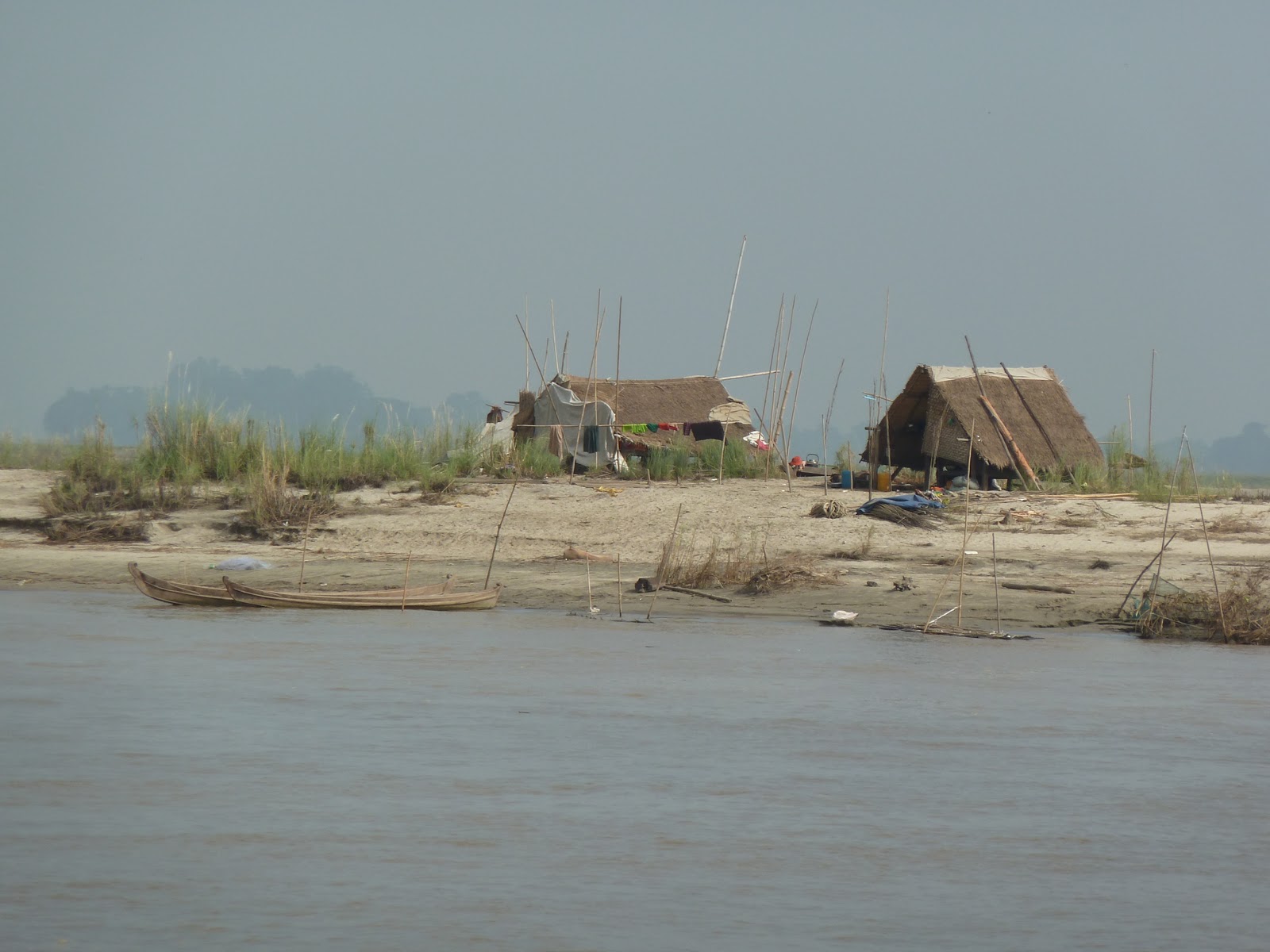
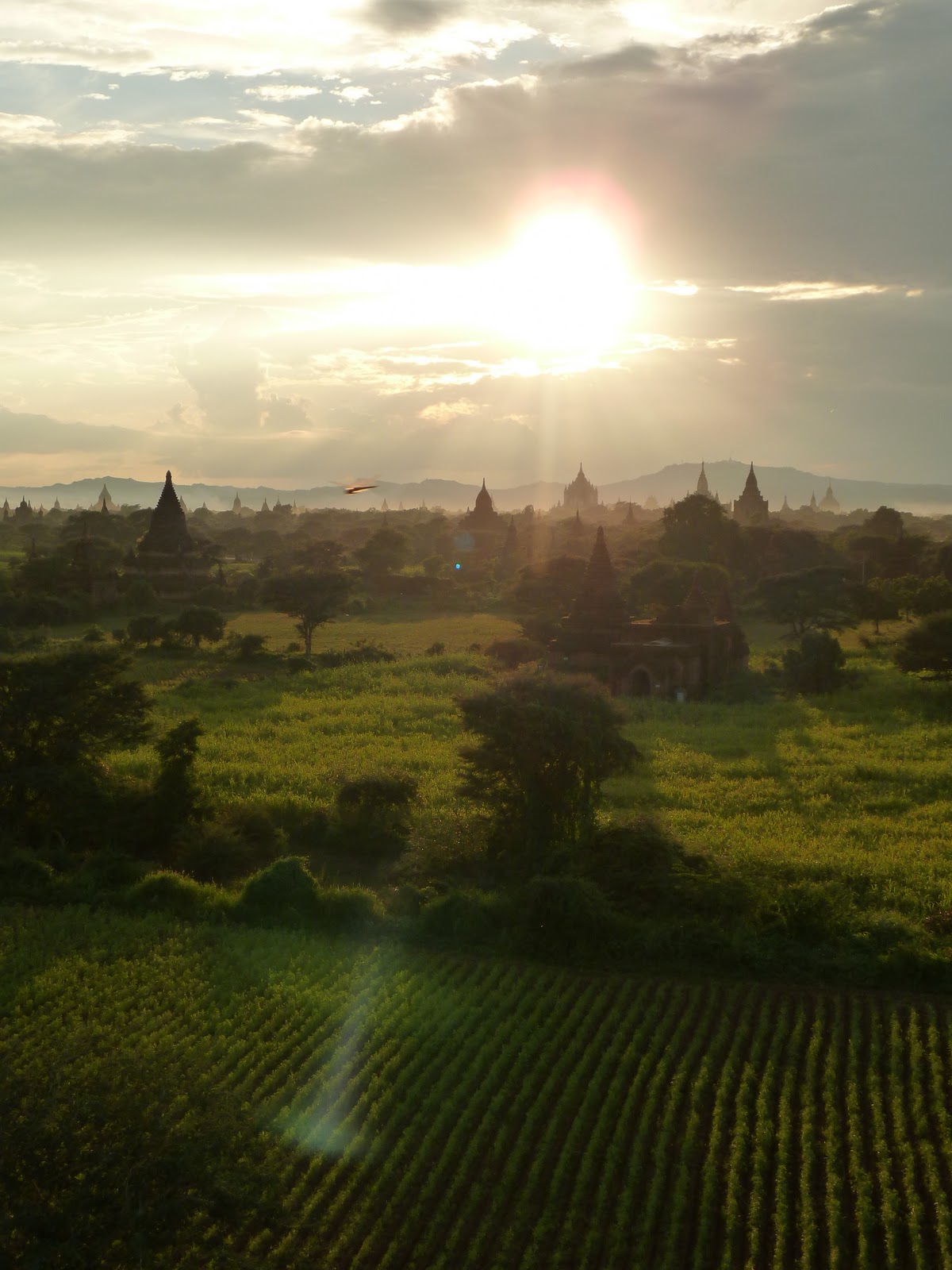
Third early morning out of four so far.  We had to leave the hotel at 5:40am this morning to catch our boat, so it was wake-up at 5am.  Our boat left just after 6am and we had no idea how long it would take to go from Bagan to Mandalay.  We’d heard estimates of 8 hours to 13 hours.  The boat held over 100 passengers, but there were only 12 of us on board.  Just after leaving shore, we saw the sunrise over Bagan, and watched two hot air balloons start their flights.  A striking scene watching the temples along the river illuminated by the morning light. 

Sunrise
I spent most of the day on the deck enjoying the breeze, reading and writing and watching life along the Ayeyarwaddy river.  Unfortunately, I spilled some coffee on my pants a few minutes after boarding, so I zipped off the bottom half to wash them out and let them dry in the sun.  Apparently this wasn’t the best idea, as one of the boat workers became interested.  J.P. got a picture of him staring at me while I applied sunscreen.  I noticed him watching me during of the day, and trying to talk to me, and tried to ignore him.

At some point we were offered the option of lunch.  Since I didn’t know what time we’d be eating again, I accepted.  It turned out to be steamed rice with a fried egg and peanuts.  Nothing too exciting but somewhat filling; most of us ate on the deck.  When the heat and sun became too much and I went inside to enjoy the air-conditioning.  I read some more and chatted with Donna.

We started approaching Mandalay just before sunset.  There were hundreds of gold stupas dotting the hills along the river.  And then the sun set behind the hills.  We pulled into the Mandalay port at 6pm.  Apparently the boat takes 12 hours.  As we drove into the city, I was a bit surprised by the state of the roads and buildings.  When you read about Mandalay it sounds like a sprawling metropolis.  Well, it is a large city, but its way less modern than I expected (even though I’m not sure why I expected much more from it).
Sunset on the Ayeyarwaddy
After settling in to our rooms, J.P. walked us to dinner at Mann Chinese restaurant, a few blocks away.  I ordered the sweet and sour chicken with some rice.  Elli didn’t like the flavor of her soup much, so she asked for chili sauce and ended up making the soup way too spicy.  You should have seen her face.  Ros didn’t order enough food, so after we’d all finished eating, she asked for something else.  She really is a piece of work.  I hope I get through the next couple weeks without strangling her (of course I wouldn’t but she drives everyone crazy and I’m the one who has to share a room with her).  Such a nice thought to have before bed.

Trotting around Bagan

Thursday, October 28, 2010

Today was a free day, so I didn’t wake up until 7:45am.  So nice to get a good night sleep.  J.P. had arranged for one of the horse carts to pick me up at 9:30, and after breakfast I met my driver, Kolin.  I showed him the Lonely Planet where we’d marked the temples we saw yesterday and told him to take me wherever.
My horse cart and driver
Great to be without the group and move at my own pace.  I took my time wandering around the temples and a few times asked Kolin to stop at random unnamed temples.  It was a fabulous day ending with sunset at Buledi.  The list of temples I visited, again with information from Lonely Planet, is below.

At lunch at Sarabha restaurant I ended up talking with a young German couple who asked me to join them.  They were around my age and we started talking about travelling in Myanmar.  I mentioned something about dinner last night and the conversation went as follows.
Me: Yeah, we took horse carts to dinner last night.
Guy: Where did you eat?
Me: Aroma
Guy: Yeah, we ate there too.
Girl: So you were with the old tour group that came in
Me: Yep.
Girl: We noticed you guys.  So you were the young one with all the older people.
Me: Yes, that was me, but age doesn’t really matter.
Girl: Oh, well, we felt bad for you.  You are welcome to join us for dinner tonight if you want.

I guess I didn’t realize how different our group looks, but I certainly appear to be the outsider on a tour for “older” people.
Sunset in Bagan
I didn’t end up back at the hotel until 6:30pm and we were meeting at 7:15 to go to Mae Soe’s house for dinner.  J.P. wasn’t sure what to expect as the family has never (to our knowledge) hosted a group of tourists.  We had a wonderful evening, which started with chips and roasted peanuts and ended with apples and oranges.  For the main meal, they cooked lentil soup, clear chicken soup, chicken curry, fish curry, vegetables, and long beans in a peanut sauce, all over rice of course.  Delicious.
Mae Soe and her family
We convinced Mae Soe and her brother to sit with us, though they claimed they weren’t hungry.  Her brother is a waiter at a hotel nearby and spoke excellent English.  At the end of dinner, we took pictures with the whole family.  A sister brought out some wood phone holders she’d made and Mae Soe showed us her sand paintings for us to purchase.  I would have liked a sand painting, but none of them appealed to me and the rest of the group ended up buying the lot. We finally said our goodbyes after a lovely evening.

Temples visited on my horse cart tour:
  1. Dhajaryhid temple
  2. Small temple complex and field workers
  3. Ananda Pahto – With its shimmering gold, 170-ft high, corncob-style hti shimmering across the plains, Ananda is one of the finest, largest, best-preserved and most revered of all Bagan temples.  Thought to have been built between 1090 and 1105 by King Kyanzittha, this perfectly proportioned temple heralds the stylistic end of the early Bagan period and the beginning of the middle period.  In 1990, on its 900th anniversary, the temple spires were gilded.  The remainder of the temple exterior is whitewashed from time to time. The central square measures 58 yards along each side.  The entranceways mark the structure a perfect Greek cross; each entrance is crowned with a stupa finial.  The base and the terraces are decorated with 554 glazed tiles showing Jataka scenes, thought to be derived from Mon texts.  Facing outward from the centre of the cube are four 31-feet standing buddha statues.  Only the Bagan-style images facing north and south are original; both display the dhammachakka mudra (a hand position symbolizing the Buddha teaching his first sermon).  The other two images are replacements for figures destroyed by fire in the 1600s.  All four have bodies of solid teak.  The western and eastern standing Buddha images are done in the later Konbaung, or Mandalay, style.  A small, nutlike sphere held between the thumb and middle finger of the east-facing image is said to resemble a herbal pill, and may represent the Buddha offering dhamma (Buddhist teachings) as a cure for suffering.  Both arms hang at the image’s sides with hands outstretched, a mudra (hand position) unknown to traditional Buddhist sculpture outside this temple.  The west-facing Buddha features the abhaya mudra (the hands outstretched, in the gesture of no fear).  At its feet sit two life-sized lacquer statues, said to represent King Kyanziitha and Shin Arahan, the Mon monk who initiated Anawrahta into Theravada Buddhism. 
  4. Shwegugyi – Built by Alaungsithu in 1131, this smaller but elegant pahto (temple or shrine) is an example of the middle period, a transition in architectural style from the dark and cloistered to the airy and light.  Its name means ‘Great Golden Cave’ and its corncob sikhara is a scaled-down version of the one at Ananda, while its reach marks a move towards verticality.  Inside you’ll find fine stucco carvings, a teak Buddha and stone slabs that retell (in Pali) its history, including that it took just seven months to build.  Missing from the scripts are details of its builder’s demise – Alaungsithu’s son brought his sick father here in 1163 to smother him to death.
  5. Mahabodhi Paya – Unlike any other Bagan temple, this monument is modeled after the famous Mahabodhi temple in Bodhgaya, India, which commemorates the spot where the Buddha attained enlightenment.  Built during the reign of Nantaungmya in 1215, the spire is richly coated in niches enclosing seated Buddha figures, rising from a square block. 
  6. Bupaya – On the bank of the Ayeyarwaddy this cylindrical Pyu-style stupa, named for bu (gourd), is said to date back further than any Bagan temple.  Locals claim it dates to the 3rd century; most likely it was erected around the same time as the city walls (around 850).  What’s seen now – a gold stupa above a row of crenulated terraces leading down to the water – is a complete reconstruction; the 1975 earthquake demolish the original.
  7. Gawdawpalin Pahto – One of the largest and most imposing Bagan temples. Built during the reign of Narapatisithu and finished under that of Nantaungmya, it’s considered the crowning achievement of the late period.  Its name means “Platform to which Homage is Paid”.  The most recent homage was its heavy-duty reconstruction following damage sustained in the 1975 earthquake.
  8. Mimalawg Kyaung – A nice set of chinthe (half-lion/half-dragon mythical beasts) guards the stairway leading up this small, square monastery platform, constructed in 1174 by Narapatisithu.  In front of the monastery is a brick-and-stucco Tripitaka library next to a large acacia tree.  Atop the steps, a tiered roof (with a newer gold-capped hti) contains a large sitting Buddha.  Archaeologists discovered an intricately carved 2.5 inch votive tablet here that contained 78 sculpted figures.
  9. Lunch break at Sarabha
  10. Shwesandaw Paya – The graceful white pyramid-style pagoda with steps leading past fiver terraces to the circular stupa top.  Following his conquest of Thaton in 1057, King Anawrahta built this pagoda at the center of his newly empowered kingdom.  The terraces once bore terracotta plaques showing scenes from the Jataka but traces of these, and of other sculptures, were covered by rather heavy-handed renovations.  The now-gilded zedi bell rises from two octagonal bases, which lead to the five square terraces.  This was the first Bagan monument to feature stairways leading from the square terraces to the round base of the stupa.  This stupa supposedly enshrines a Buddha hair relic, brought back from Thaton.  The hti, which was toppled by the earthquake, can still be seen lying on the south side of the paya compound.
  11. Guni temple
  12. No. 753
  13. No. 751
  14. Sulamani – This broad two-story temple is one of Bagan’s most attractive, with lush grounds behind the surrounding walls.  It’s a prime example of later, more sophisticated temple styles, with better internal lighting.
  15. Thabbeik Hmauk –This sikhara-topped temple looks like a miniature version of its more famous neighbor.  Much of its interior was damaged by the 1975 earthquake, but there are multiple stairways up to a wrap-around meditation chamber with little light.  There are two outside terraces, reached by narrow stairs, with superb views.
  16. Buledi (sunset) – Great for its views, this steep-stepped, pyramid-style stupa looks ho-hum from afar.

Temple mania

Wednesday, October 27, 2010

Is it possible we just arrived in Bagan this morning?  Seriously.  The day has been so busy I feel like I’ve been here a couple.  This place is amazing.  Temples, temples and more temples with loads of stupas thrown in.  Everywhere you look there is another one; the plain the size of Manhattan has as many red-brick temples as Europe has medieval cathedrals (just to give you a sense of scale).  In its heyday, Bagan had over 4,400 temples in the 26-square mile area, the building of which only took place in only 230 years.  Anyway, it is incredible.

Background on Bagan (from Lonely Planet):
The extraordinary religious fervor that resulted in this unique collection of buildings lasted two and a half centuries.  Although human habitation at Bagan dates back almost to the beginning of the Christian era, Bagan only entered its golden period with the conquest of Thaton in AD 1057.  Bagan was already in decline by 1287 when it was overrun by the Mongols of Kubali Khan.
  • Early period (c 850 – 1120): This period was influenced by Mon and late Pyu architecture and is characterized by perorated windows and dimly lit interior
  • Middle period (c 1100 1170): Temples became bigger during this period and were better lit by broader windows, with more of an eye to vertical proportions than horizontal lines
  • Late period (c 1170-1300): The late period saw more intricate pyramidical spires or adorning tile work added to the buildings, with an increase of Indian influence, and (some say) a seeping in of Mahayana Buddhism influence

We had a 6:45am flight, which meant another 3:45 wake-up call and breakfast box.  When we arrived at the airport, J.P. sat us down and went off with Tina to deal with our tickets and bags.  After saying goodbye to Tina, the only thing we had to do was go through security.  Guess that’s the nice thing about being on a tour.

We were on one of those smaller planes, 4 per row, where you board from the back.  I sat next to J.P. and got to pick his brain a bit on South America.  Just before landing, we could see the temples of Bagan through the plane window.  The drive to Thante Hotel gave an introduction to the incredible scale of this place.

Subsequent to checking in, we drove to Nyaung U market for some optional shopping among the locals.  I couldn’t believe how many children approached us when we stepped off the bus.  The market had tons of stalls, there was an area selling fruit and vegetables, meat or fish, lacquer ware and other souvenirs, or clothing and shampoo the list goes on, but in general it was just a lot of stuff.  I still wonder how all these people make a living.  Once we left the market, it was temple time.


The temples were amazing, but the numerous vendors outside each one, many selling the same goods, got tiring.  Time after time I had to say no to young children trying to sell postcards and souvenirs.  Eventually, I bought a pack of postcards from one kid and some bracelets from another. 

Our guide, in broken, somewhat hard-to-understand English, told us copious amounts of information at each temple.  I found it interesting, although I don’t remember most of it now having seen so many temples, but most people in my group felt it was excessive.  While the current state of the temples is impressive, it is hard to imagine how the plain looked back in 1200 when all of the brickwork was covered by stone design and the inside walls were coated in murals.  (I’ve listed the temples we visited below and have included some information from Lonely Planet to give a bit more color to the area.  It’s so vast and after a while, all the pictures and temples start to look similar.)

At the first temple, we climbed the outside stairs to get our first somewhat aerial view of the area.  Spectacular; I think I could see at least 30 temples nearby and hundreds more in the distance.  I took a photo of the girl who pestered me into buying postcards.  Our next stop was a big paya which Shwedagon Paya in Yangon was based on.  After two more temples, we stopped at Shwe Myanmar for lunch, where we were served a collection of Myanmar dishes.  I especially enjoyed the long beans in peanut sauce.  From lunch we were taken to a lacquer ware workshop to see the process from bamboo pieces to painted artwork.  I purchased two small bowls to use as candy dishes.

Even though some of the group was tired, we pressed on; I was anxious to take advantage of our free guide and transport.  At some point, the driver took Donna back to the hotel since she’d had enough.  The rest of us visited seven more temples to pass the day until sunset, which we spent on the top of Dhammayazika.  It was a gorgeous setting, but a patch of clouds blocked the sun dipping below the horizon. 


Arrived back at hotel around 6:30 and met for dinner at 7:45pm.  J.P. found a restaurant, but it required horse carts, of which he ordered three, since it was slightly too far to walk.  It was a pleasant ride but too dark to see anything.  J.P.’s Myanmar contact, Mae Soe, who he met last time he visited Bagan, joined us for an Indian meal at Aroma restaurant while Ros and Jacek stayed back.  After ordering it took about an hour to get our food and everyone was hungry, tired, and annoyed for having to wait so long.  We were served on banana leafs with five side dips.  I had my go-to chicken tikka; it was tasty, but not that hot and not really worth the wait.  Our horse cart drivers sat and waited until we finished dinner.

Tomorrow is a free day, so I’m going to explore on my own in a horse cart.  Everyone else is joining J.P. for a trip to Mount Popa, but I feel like I need more time to explore Bagan. 

Temples we visited:
  1. Bulethee (Buledi) stupa (for view)
  2. Shwezigon Paya – This big and beautiful zedi is the town’s main religious site, and is most famous for its link with the 37 nat.  The gilded zedi sits on three rising terraces.  Enameled plaques in panels around the base of the zedi illustrate scenes from the Jataka.  At the cardinal points, facing the terrace stairways, are four shrines, each of which houses a 13ft-high bronze standing buddha.  Gupta-inspired and cast in 1102, these are Bagan’s largest surviving bronze buddhas.  A four-inch circular indentation in a stone slab was filled with water to allow former Myanmar monarchs to look at the reflection of the hti (an umbrella like decorated pinnacle) without tipping their heads backwards (which might have caused them to lose their crowns).  The most important site here is the small yellow compound called 37 Nat (in English) on the southeast side of the site.  Inside are figures of all the 37 pre-Buddhist nat that were officially endorsed by Bamar monarchy in a compromising gesture towards a public reluctant to give up all their beliefs for Buddhism.  At one end stands an original figure of Thagyamin, king of the nat and a direct appropriation of the Hindu god Indra.  This is the oldest known freestanding Thagyamin figure in Myanmar.  The site was started by Anawrahta but not completed until the reign of Kyanzittha.
  3. Wetkyi-in-Gubyaukgyi – This detailed 13th-centry temple has an Indian-style spire.  It is interesting for the fine frescoes of scenes from the Jataka but, unfortunately, in 1899 a German collector came by and surreptitiously removed many of the panels on which the frescos were painted.  Those that remain in the entry are in great shape.  Steps inside lead to four Buddha images and you can see Hindu figures engraved on the spire.
  4. Htilominlo Pahto – This 150ft-high temple (built in 1218) marks the spot where King Nantaungmya was chosen (by a leaning umbrella), amongst five brothers, to be the crown prince.  It’s more impressive from the outside, with its terraced design.  Around the 140 square-foot base are fragments of the original fine plaster carvings, glazed sandstone decorations and nicely carved reliefs on the doorways.  Inside traces of old murals are still visible.
  5. Lunch and  Utun Lacquer ware shop break
  6. Nan Paya – This shrine is said to have been used as Manuha’s prison, although there is little evidence supporting the legend.  In this story the shrine was originally Hindu, and captors thought using it as a prison would be easier than converting it to a Buddhist temple.  It’s worth visiting for its interior masonry work – sandstone block facings over a brick core, some of Bagan’s finest detailed sculpture.  Perforated stone windows are typical of earlier Bagan architecture –it was probably Bagan’s first gu-style shrine.  In the central sanctuary the four stone pillars have finely carved sandstone bas-relief figures of three-faced Brahma.  The creator deity is holding lotus flowers, thought to be offerings to a freestanding Buddha image once situated in the shrines centre, a theory that dispels the idea that this was ever a Hindu shrine.  The sides of the pillars feature ogrelike kala-ate heads with open mouths streaming with flowers.  Legend goes that Shiva employed such creatures to protect temples, but they proved too ferocious so Shiva tricked them into eating their bodies, then fed them flowers to keep their minds off snacking on worshippers.  In the center of the four pillars is an altar, on which once stood a standing Buddha or a Hindu god.
  7. Manuha Paya – Pagoda named after the Mon king from Thaton, who was once held captive here by King Anawrahta.  In the front of the building are three seated buddhas; in the back is a huge reclining Buddha.  All seem too large for their enclosures – supposedly representing the stress and discomfort the king had to endure.  It is said that only the reclining Buddha, in the act of entering parinib-bana (final passing away), has a smile on its face, showing that for Manuha, only death was a release from his suffering.  However, the face of the sitting Buddha on the top of the paya has an equally gigantic smile.
  8. Dhammayangyi Pahto – Visible from all parts of Bagan, this massive, walled, 12th century temple is known locally as a ‘bad luck temple’.  Some believe this is because of the ruthless king Narathu who mandated that the mortarless brickwork fit together so tightly that even a pin couldn’t pass between any two bricks.  After he died – by assassination in 1170 – the inner encircling ambulatory was filled with brick rubble – as ‘payback’, most say.  The plan has projecting porticoes and receding terraces, though its sikhara is reduced to a stub nowadays.  Walking around the outer ambulatory, under ceilings so high you can only hear the squeaks of bats circling in the dark, you can see some intact stucco reliefs and paintings, suggesting the work had been completed.  Three out of the four Buddha sanctums were also filled with bricks.  The remaining western shrine features two original side-by-side images of Gautama and Maitreya, the historical and future buddhas (it’s the only Bagan site with two side-by-side buddhas).
  9. Thatbyinnyu Pahto (aka Minyeinkore) – Named for ‘omniscience’, Bagan’s highest temple is built of two white-colored boxy stories, each with three diminishing terraces rimmed with spires and leading to a gold-tipped sikhara, 207ft up.  Its monumental size and verticality make it a classic example of Bagan’s middle period – and neatly provide a chronological link between early-period Ananda and late-period Gawadpalin.  Built in 1144 by Alaungsithu, its terraces are encircled by indentations for 539 Jataka.  Plaques were never added, leading some scholars to surmise that the monument was never consecrated.
  10. Lokahteikpann temple (Lawkahteikpan) – a small but interesting middle-period gu containing excellent frescoes and inscriptions in both Burmese and Mon.
  11. Unknown temple for views
  12. Dhammayazika Paya (sunset) – This pentagonal zedi is similar to the Shwezigon but with a more unusual design.  Sitting in lush green grounds with a gilded bell, the Dhammayazika dates from 1196.  An outer wall has five gateways.  Up top, five small temples, each containing a Buddha image, encircle the terraces; some of them bear interior murals added during the Konbaung era.

I’m in Myanmar! City of Yangon

Tuesday, October 26, 2010

I really can’t believe I’m in Myanmar.  Wow.  It has been a full on day and I’m totally spent.  I had a poor night sleep due to Roslyn’s loud snoring, which she wasn’t sure she did until I informed her this morning. We were up at 3:45am, left the hotel at 4:30 and arrived at the airport for check-in before 5:30.  By the time we got to the gate, I had less than 30 minutes to grab a Pretzel and coffee (the hotel breakfast box wasn’t very satisfying).  The Air Asia flight departed basically on-time at 7:15am and we landed in Yangon at 8am.  There’s an odd 30 minute time difference between Thailand and Myanmar.  I wonder if they do it just to be different.

Our local guide was enthusiastically waving at us from the other side of passport control, as we queued to enter the country.  No questions asked, just a scan of the passport and visa, a quick picture, stamp, and you’re in.  When we were all finished, we boarded the mini-bus and headed to Panorama Hotel in the city center.  On the bus Thanda (aka Tina) gave us welcome gifts, the ever popular traditional longyi, a sarong-like lower garment worn by men and women, and showed us how to wear them. Ros and my room, on the top floor, has an amazing view overlooking the city onto the Shewdagon Paya and Sule Paya.  After a quick refresh, we hopped back on the bus for a full day exploring Yangon.

The driver of the bus was sitting on the right side, and we boarded on the left side, even though people drive on the right side of the road.  Apparently, as a result of independence from the British, Myanmar changed from driving on the left to driving on the right.  However, many buses and open-taxis are from colonial times and therefore still have wheels on the right-hand side.  So we had to board the bus from the middle of the road.  Interesting system, but I guess it works.

Even though it was not yet noon, our first stop was lunch at a sophisticated jungle-shack restaurant Feel Myanmar Food.  It was basically a buffet with a huge selection of Myanmar curries and side dishes.  Not knowing what Myanmar cuisine tasted like, I ordered the squid curry and a spicy eggplant salad (mashed up like baba ganoush).  We were served rice and soup; I thoroughly enjoyed the cuisine, which is much less spicy than Thailand.  J.P. treated us to lunch as a “welcome to Myanmar” gift.  After filling our bellies, we stopped at Chaukhtatgyi Paya, housing a large reclining Buddha topped by a crown encrusted in diamonds and other precious stones.  While the Buddha was photo worthy, some local children captured the lenses of our group. 

On the bus, Tina informed us that the Myanmar flag was changed three days ago in preparation for a new beginning after the election.  Once red (for bravery) with a navy square (for stability) in the corner with 14 stars (representing the 14 states and divisions) and a design in the middle representing the farmers and workers, the flag is now 3 stripes, yellow (for the various religions), green (for unity) and red (for bravery), with a white star (representing the people, or as some believe the military) in the center.

Next was Bogyoke Aung San Market (aka Scott market), a 70 year-old market with over 2000 shops.  Tina showed us how to make thanakha, a yellow sandalwood-like paste worn by many Myanmar women on their faces as a combination of skin conditioner, sunblock and make-up, by rubbing the wood with water against a stone.  In the 45 minutes we had to explore, I managed to purchase a necklace and earrings but refrained from buying anything else even though the locals were promoting their goods like crazy.  The group was getting tired, especially from the heat, but agreed to go for a walk through the city center, passing the Theingyi Zei (the biggest market in Yangon) and many stalls along the street selling food and handicrafts.  Our destination was, on my request, the Moseah Yeshua Synagogue (since I was shocked that there was a synagogue in Myanmar), founded more than a hundred years ago by Sephardic Jews whose population which was around 2500 until nationalism when people slowly started leaving; the remaining Jewish population is now about 25. 

Gauging the exhaustion of the group, J.P. suggested an hour and a half break at the hotel, promising me that we wouldn’t miss seeing anything on the itinerary.  I passed out for over an hour, fatigued from the heat and lack of sleep last night.  Post nap time, we drove to the jetty to see the Yangon River and life on the port, before visiting the 2,500 year-old Shwedagon Paya, the most sacred of all Buddhist sites in Myanmar.

We took the lifts to the top of the 12-acre complex, 190 feet above sea level, and spent the rest of the afternoon wandering around the small zedi, statues, temples, shrines, images and tazaung (small pavilions) which surround the main, solid gold encrusted zedi (stupa).  The top-most vane is gold- and silver-plated and studded with 1100 diamonds totaling 278 carats, in addition to 1383 other stones.  At the very top of the vane rests the diamond orb – a hallow golden sphere studded with 4351 diamonds, weighing 1800 carats in total; the very top of the orb is tipped with a single 76-carat diamond.  From a certain angle on the platform, you could see a bit of white light reflecting from the main diamond.  Interesting to see so many jewels on a religious site when most of the people in this country are impoverished.

By the time we left, the sun had long past set and we journeyed to Kandawgyi Lake for views of Shwedagon Paya and Karaweik (an expensive government-financed project with a reinforced concrete reproduction of a royal barge, where tourists can enjoy dinner and traditional dance performances).  We were headed for dinner elsewhere.  Since ours is the first trip GAP adventures has run in Myanmar since 2007, J.P. is actively researching for future groups.  He wanted to check out Monsoon restaurant, listed in Lonely Planet as possibly the best Southeast Asian restaurant in Yangon and housed in a classical colonial town house.  I ordered a banana lassi and a chicken curry Tina recommended, while Tina ordered the butter fish curry that I’d been eyeing.  I should have gone with my instinct and ordered the butter fish curry as it was delicious, but luckily Tina ate some of my dish and we shared.  Jacek generously picked up the tab (keeping up with J.P. in setting a tradition that can’t be sustainable), which had to be expensive given that some people ordered drinks, but relatively cheap for a group of nine.
Me and Tina
I’ve showered and am ready to pass out in bed.  Putting ear plugs in tonight in hope of better sleep.

Some info about Myanmar

Before I start posting about my time in Myanmar (formerly known as Burma), I thought I would include some information from Lonely Planet and Burma: The Alternative Guide since little is known about the country.  Lonely Planet addresses the issue of whether it is “right” to visit the country since some tourist dollars ultimately goes to the government.  Feel free to read as much or as little as you like.

“Burma is known as the land of the golden pagodas, with an ancient culture and a religious tradition that have persisted right through to the present day.  It is a country of many different races and creeds, though little is known about some of the minority groups.  Thanks to the predominance of Buddhism, the tourist will find himself choosing between thousands of temples and shrines, but beneath this shining, tranquil surface lies a history of bitter conflict” (Ganz 7).

“Visitors require permission from the tourism authorities to enter various parts of the country, and there are some towns and regions that foreigners are simply not allowed to enter…. Travelers’ checks and credit cards are rarely accepted in Burma, and tourists usually have to pay for accommodation and travel in US dollars, which invariably goes straight to the military” (Ganz 7).

Population estimates range between 50 and 55 million, but there has never been a reliable census and the last one took place in 1983.  The former capital of Yangon was moved to Naypyidaw in November 2005.

“Six decades since independence from Britain, Myanmar remains a rocky work in progress.  In fact, it’s never enjoyed stability for long.
Squabbling kingdoms plagued the area for hundreds of years, till the British took it in three waves in the 19th century.  Britain managed the mountainous border regions separately from the fertile plains and delta of central and lower Myanmar, building on a cultural rift between the lowland Bamar and highland ethnic groups that lingers today.  Civil war erupted between minority groups after independence in 1948, and continues still.
General Ne Win wrestled control from a failing government in 1962 and began the world’s longest-running military dictatorship, which quickly pursued xenophobic policies and led the country to full isolation.  Ruined by a rapidly deteriorating economy and a major currency devaluation in the 1970s and 80’s, many thousands flooded the streets – peacefully – on 8 August 1988.  The prodemocracy marches saw Aung San Suu Kyi emerge as a leader, who was recognized worldwide.  After a violent reaction by the military, the administration, to everyone’s surprise, called a national election.  It thought it couldn’t lose.  But it did.  At the 1990 election, Aung San Suu Kyi’s National League for Democracy (NLD) won 82% of the assembly seats, but the military refused to transfer power.
In the years since, Myanmar’s neighbors (particularly China) and its membership in Asean (since 1997) have ensured that the government has been able to withstand increased scorn from the USA and EU.  But in 2007, after gas prices jumped by 500%, nationwide protests erupted for the first time since ’88.  The world watched as the generals’ army clamped down, leaving a number of fatalities in the streets.  Then, on 3 Mary 2008, Cyclone Nargis tore through the Ayeyarwaddy Delta, claiming nearly 140,000 lives.  The government blocked any foreign help for weeks, as some local groups and monks strove to get food and supplies to victims.
Many outsiders hoping for democracy… feel that the past two decades have been a waste of time and are beginning to wonder if it’ll take more than peaceful marches to ignite any meaningful communication” (Lonely Planet, History).

“Since 1987, Burma has been classified by the United Nations as a least developed country (LDC), which is based on the criteria of low income, weak human resources and economic vulnerability… Poverty is widespread, with many barely scraping a living from the land, while wages are generally very low…. Thanks to the catastrophic policies of the military dictatorship, the health system is in an appalling state.  Only 3% of the national budget is devoted to it, while almost 50% is spent on arms” (Ganz 10).

In 1886 Burma lost its independence and became a province in the British colony of India.  The British were driven out in 1942 by the Japanese, but it wasn’t until January 1948 that Burma officially gained independence.  Even with a new prime minister and president, there was political instability and in 1962, the military leader Ne Win staged a coup.  In 1989, General Saw Maung set up the State Law & Order Restoration Council whose first task was to rename Burma the “Union of Myanmar” and to give new names to many towns and rivers.

International pressure forced the junta to hold free elections in 1990, which resulted in a landslide victory for the National League for Democracy (NLD) but the military refused to hand over power.  I fear the elections coming up on 7 November will result in much the same way.

“A visit to Burma will produce many highlights of culture and landscape, but the country also has a darker side that may not be immediately apparent.  In the shadows of its pagodas, the people are suffering under a brutal dictatorship that has plunged Burma into economic, cultural and spiritual ruin.
In the border regions, a civil war is being waged against the non-Burmese either peoples, who are fighting for freedom and self-determination.  Burmese troops continually rape the women of these ethnic minorities, while farmers are arrested at random or even shot without cause as they make their way to the fields…. Burma has the largest arm of children in the world, numbering 70,000.  These children have virtually no chance to flee this forced recruitment, and any escape is punished with torture or imprisonment. …
The military junta shows no mercy to its political opponents, and any assembly of more than five people can be classed as a demonstration, with severe consequences. …
Burma holds a collection of world records that the visitor will not be aware of: it has the longest-ruling military dictatorship in the world; it has been classified by the World Bank as one of the worst governments in the world; and in 2007 Transparency International also ranked Burma as the most corrupt country in the world” (Ganz 138-139).

“No-one argues Myanmar isn’t one of the world’s most exciting destinations, but a complex question mark has hovered over the country since the birth of a tourism boycott in 1995.  Does your money, no matter how carefully spent, sustain a military dictatorship that has imprisoned political dissidents, used forced labor, cracked down on peaceful demonstrations and seized foreign aid (most notably following Cyclone Nargis in May 2008)?  Or does isolating one of the world’s poorest countries not only deprive a burgeoning private sector of income, but also push the government into the arms of neighbors with bigger bankrolls and their own serious human rights issues?” (Lonely Planet)

Reasons Not to Go (from Lonely Planet)
  • The government used forced labor to develop tourist-related sights and services
  • Thousands of families have been forcefully relocated to make room for some tourism facilities, such as Old Bagan
  • International tourists can be seen as a symbolic stamp of approval for the Myanmar government
  • It’s impossible to visit without some money going to the military junta
  • Activists claim that tourism dollars help directly fuel government repression
  • The government forbids travel to many areas, particularly those inhabited by minority groups, due to unrest

Reasons to Go (from Lonely Planet)
  • The vast majority of locals you meet – including many veterans of the 1988 prodemocracy protests – want you to come
  • The majority (possibly 80%) of a careful independent traveler’s expenses goes to the private sector, a higher percentage than the government allocates for the public
  • Many observers point out that a four-decade (and going) trade boycott against Cuba never changed its leadership, and Myanmar gets more outside investment than Cuba
  • Through ‘direct aid’ efforts, visitors can help a local community facing a humanitarian crisis
  • As outside communication is regulated, tourism provides an open two-way exchange between many locals and the outside world
  • Human-rights violations are less likely to occur in areas where international visitors are present


Sources:
Ganz, Nicholas and Elena Jotow.  Burma: The Alternative GuideThames & Hudson, 2009.
Lonely Planet.  Myanmar (Burma).  Lonely Planet Publications Pty Ltd, 2010.

Meet and greet (T2 Day 1)

Monday, October 25, 2010

This morning I had a long bus ride from Sukhothai to Bangkok (where I'm meeting my tour - can't believe I'm on the last three weeks of my trip in Asia).  My bus left at 7:45am, so I had to leave the hotel at 6:30am to make sure I arrived at the station on time.  For second-class, the bus was nicer than I expected and I spent most of the ride listening to podcasts (which I only just discovered.  They are fabulous!).  At the bus station, it proved hard to get a taxi who could understand where I needed to go, but a young local girl helped me out.  Got to hotel around 4pm and found out that my roommate was already checked-in.  I went to the room in nervous anticipation and met my roommate for the next 3 weeks, Roslyn a 45-year old Australian nurse.  She didn’t stop talking for the two hours before we had our group meeting, even though she was trying to watch TV.  I hope this isn’t a glimpse of the next three weeks.

There’s Donna and Norm, 68 and 70 respectively, from Canada, Elizabeth and Jacek, in their 50s, from Canada (although they’re originally from Poland and still have their accents after 20+ years in Canada), and Ellie, 43 from Athens.  That puts me 16 years younger than the next youngest person.  Not that age matters, but it would have been nice to have someone a bit closer to my age.  Oh well.  Some people seem nice enough, although it’s definitely an interesting mix of people.

The most important aspect however is the tour guide, and J.P. seems awesome.  He’s been leading tours all over the world for the last 13 years and grew up in Norway.  The introduction meeting lasted an hour, and we had 30 minutes to hang out before walking to dinner.  J.P. took us to a great Thai restaurant where I ordered squid in a red curry.  Everyone seems friendly, but its not necessarily the group I would have picked for three weeks.  Don’t think this group will ever live up to the wonderful companions I had on the Trans-Mongolian.

The group - Me, Elizabeth, Jacek, Elli, Roslyn, Donna, Norm
Tomorrow we have a very early morning wake-up, 3:45am to go to the airport for our flight to Myanmar.  Can’t wait to get there!

World Travels Map