After five years working in London, I decided it was time to move back to Los Angeles, but not before taking a year off to see the world. I gave up my great job with Lehman Brothers in Administration and a fantastic flat (and roommate) I’d lived in for over three years, packed up all my belongings into some 60 cubic feet of boxes and said farewell to the wonderful friends I made in London. Before setting off for Asia, I spent seven weeks in the States including a weekend getaway in Chicago with my best friends from high school, corrective eye surgery in Philadelphia, Aud and Rob’s wedding in Bermuda, 13 days in Israel on Birthright (with a side trip to Petra) and time in quiet Oak Park with my parents and sister. Then, on July 18, 2010 at 1am, with only 13 kilograms in my 50L backpack and a small shoulder bag, I boarded a flight to Singapore. The goal of my adventure is not one of self-discovery or mending a broken heart but a journey of true desire to explore the world, experience new cultures, taste various cuisines, explore beautiful wildernesses, meet local people, and maybe learn some Spanish along the way. What lies below are my stories (or more of a daily recount of events) from the road.

Sunday, November 14, 2010

Tonle Sap + Temples

Thursday, November 11, 2010

Our last day in Siem Reap began, at 8am, with a drive to Tonle Sap, the main water source in central Cambodia.  The current reverses direction after the rainy season.  We hired a small boat to take us out to the lake and Kim, our guide, explained how drastically the water level changes (four times larger in the rainy season) allowing for a large fish population.  Apparently the Chinese want to build a dam somewhere along the Mekong which would greatly impact the natural process of change (fortunately there is a Mekong council to discuss such issues).  We stopped in a lake town to visit the school, wat and see local life.  Sadly, we were not the only tourists and J.P. remarked that the kids are now getting distracted from lessons.  What stuck out to me was the large quantity of trash on the ground, lining the “streets” or in piles for burning.  There needs to be a community service project to clean up the village and educate about trash (once again, like Vietnam, these communities weren’t used to wrapped foods).

While we were on motoring along the lake, I noticed that Ros was wearing a blood donation t-shirt.  Considering that she never actually gave blood, I found it ironic that she chose to wear the shirt in front of us.  Maybe she ran out of clean clothes.  Don’t know why she got one in the first place unless she considers having her period a donation.

On the hour ride back to Siem Reap we learned about the Rolous group of temples, two of which we were visiting, built in the late 9th century.  We had limited time to walk around the Preah Ko complex but it was very compact.  It reminded me of Prambanan in Java, Indonesia.  At the second temple, Bakong, the group took a few minutes photographing the temple from afar.  When we reached the entrance to the temple, Kim started telling us the history.  Ros rudely interrupted him saying like “we only have 20 minutes and we just wasted five taking pictures so can you hold off until we get to the van”.  I couldn’t believe her.  First of all, no one said anything about a time limit at the temple.  Secondly, its just inconsiderate to speak to your local guide in that manner.  Kim ended up answering some questions from Donna, Norm and me.  A few minutes later, Ros had the nerve to ask what he had told us. I really thought I was going to tell her off; I reached a breaking point.  Instead, I just told Donna about it and chose to ignore Ros.
Preah Ko
Information on the Rolous group from my Footprint guidebook:
“Jayavarman II built several capitals including one at Roluos, at that time called Hariharalaya.  This was the site of his last city and remained the capital during the reigns of his three successors.  The three remaining Hindu sanctuaries at Roluos are Preah Ko, Bakong and Lolei.  They were finished in 879, 881 and 893 respectively by Indravarman I and his son Yashovarman I and are the best-preserved of the early temples.  All three temples are built of brick, with sandstone doorways and niches.  Sculptured figures which appear in the Roluos group are the crouching lion, the reclining bull (Nandi – Siva’s mount) and the naga (snake).
            Preah Ko, meaning ‘sacred ox’, was named after the three statues of Nandi (the mount of the Hindu god, Siva) which stand in front of the temple.  Orientated east-west, there is a cluster of six brick towers arranged in two rows on a low rick platform, the steps up to which are guarded by crouching lions while Nandi, looking back, blocks the way.  The front row of towers was devoted to Indravarman’s male ancestors and the second row to the female.  Indravarman’s temple-mountain, Bakong, is a royal five-stepped pyramid-temple with a sandstone central tower built on a series of successively receding terraces with surrounding brick towers.  Indravarman himself was buried in the temple.”
Bakong
It was already after 1pm when I got back to Siem Reap town (the rest of the group was continuing to a silk factory) and I grabbed a quick sandwich and smoothie at Blue Pumpkin before treating myself to an ice cream on the way out.  In search of a tuk tuk driver, but not wanting to accept the ones who were hawking me, I walked down the street.  The guy I approached didn’t speak English well, but his friend, who came over to see where I wanted to go, ended up becoming my driver.  We started the long ride to Banteay Srei; it took over an hour to get there.
Banteay Srei
I spent only 30 minutes exploring the temple but I didn’t feel I needed any more time.  The main area of the temple was compact but the detailed carvings were beautiful.  I would try to describe what I saw but the guidebook can give more information:
“Banteay Srei was built by the Brahmin tutor to King Rajendravarman, Yajnavaraha, grandson of Harshavarman, and founded in 967.  Banteay Srei translates to ‘Citadel of Women’, a title bestowed upon it in relatively recent years due to the intricate apsara carvings that adorn the interior.  The temple is considered by many historians to be the highest achievement of art from the Angkor period.  The explicit preservation of this temple reveals covered terraces, of which only the columns remain, which once lined both sides of the primary entrance.  In keeping with tradition, a long causeway leads into the temple, across a moat, on the eastern side.  The main walls, entry pavilions and libraries have been constructed from laterite and the carvings from pink sandstone.  The layout was inspired by Prasat Thom at Koh Ker.  Three beautifully carved tower-shrines stand side by side n a low terrace in the middle of a quadrangle, with a pair of libraries on either side enclosed by a wall.  Two of the shrines, the southern one and the central one, were dedicated to Siva and the northern one to Vishnu; both had libraries close by, with carving depicting appropriate legends.  The whole temple is dedicated to Brahma.  Having been built by a Brahmin priest, the temple was never intended for use by a king, which goes some way towards explaining its small size – you have to duck to get through the doorways to the sanctuary towers.  Perhaps because of its modest scale Banteay Srei contains some of the finest examples of Khmer sculpture.  Finely carved and rare pink sandstone replaces the plaster-coated carved-brick decoration, typical of earlier temples.  All the buildings are covered in carvings: the jambs, the lintels, the balustered windows.  Banteay Srei’s ornamentation is exceptional – its roofs, pediments and lintels are magnificently carved with tongues of flamer, serpents’ tails, gods, demons and floral garlands.”
Banteay Srei
On the way back to Angkor, J.P. suggested I stop at the Landmine museum.  I thought I’d make a quick run through it due to its small size, but I was captivated by the movie showing how Aki Ra finds and destroys the mines.  He is nominated in the top 10 CNN heroes of 2010.  Fascinating story.  More information on CNN.

It was coming on 5pm by the time I left the museum, and my tuk tuk driver sped me back for sunset at Pre Rep.  "Pre Rup, the State Temple of King Rajendravarman's capital, was built in 961.  The temple-mountain representing Mount Meru is larger, higher and artistically superior than its predecessor, the East Mebon, which it closely resembles.  Keeping with tradition of state capital, Pre Rup marked the centre of the city, much of which doesn't exist today.  The pyramid-structure, which is constructed of laterite with brick prasats, sits at the apex of an artificial, purpose-built mountain.  The central pyramid-level consists of three-tiered, sandstone platform, with five central towers sitting above.  Its modern name, 'turning the body', derives from local legend and is named after a cremation ritual in which the outline of a body was traced in the cinders one way and then the other.  The uppder levels of the pyramid offer a brilliant, panoramic view of the countryside." Unfortunately, as I had anticipated, there were too many clouds to see much, but I did have a chance to discover the temple, another temple-mountain pyramid-style structure.  I’m glad I fit a couple more temples in, and even though there are still more than 200 to explore, I feel I’ve gotten a good sampling of Angkor.

Pre Rup
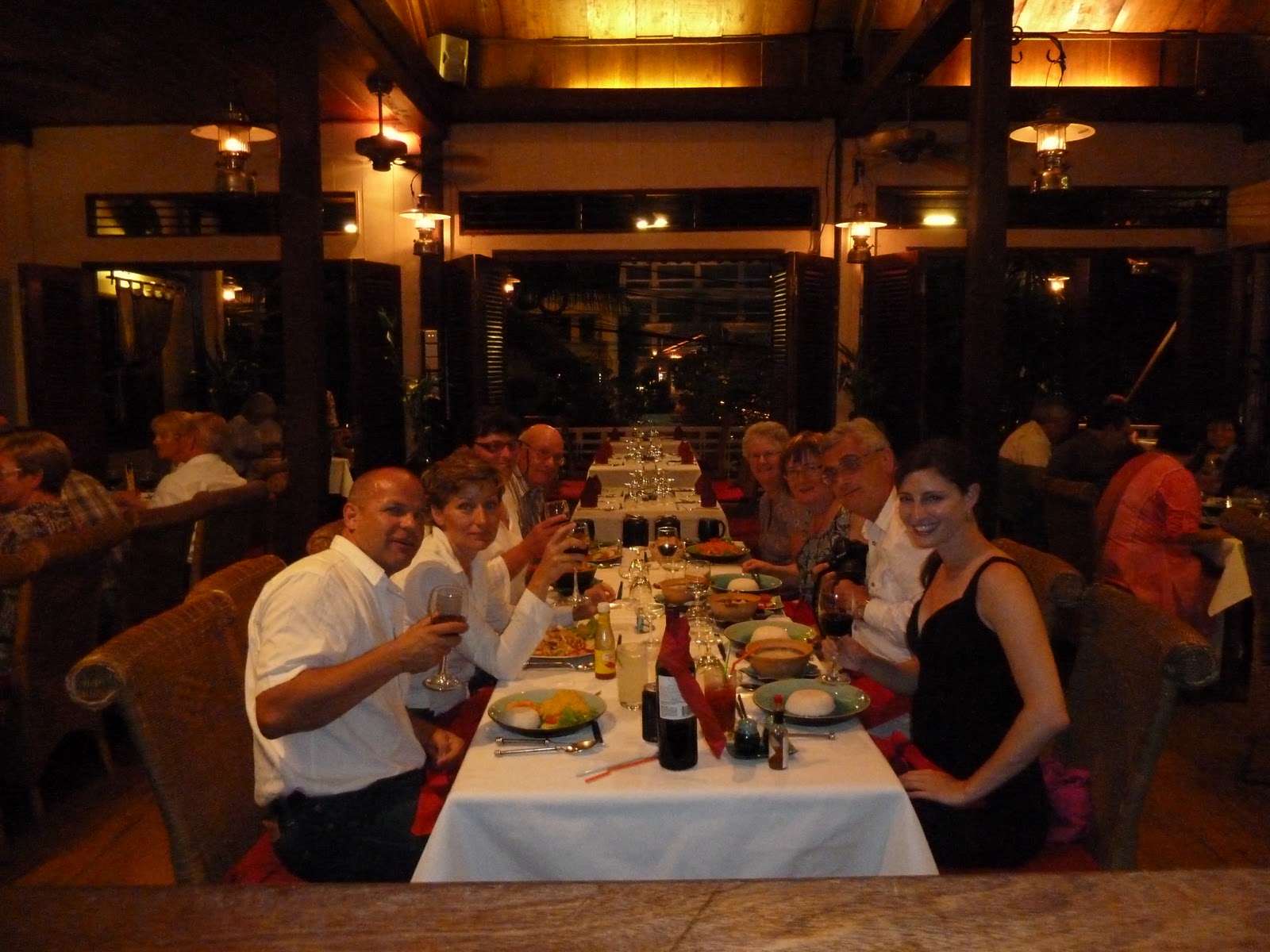
In honor of Ela and Jacek’s 32nd anniversary today, I showered and dressed up for dinner.  We met in the lobby just after 7pm, everyone looking lovely in their best clothes and got in tuk tuks for the short ride to Café Indochine.  Ela and Jacek kindly treated us to a bottle of champagne and a bottle of wine and I had a delicious curry-like soup with prawns.  It was a wonderful evening.  For a bit of exercise, Elli, Ela and I walked  back to the hotel.  On the way, I stopped at the gas station to withdraw some money as they stood guard; pretty funny scene.  That’s all for now.


Me with the happy couple

Amazing Angkor

Wednesday, November 10, 2010

Today was amazing, but exhausting.  It’s 5pm and I’ve been awake now for 13 hours.  I feel like I’m going to fall asleep on the table.  We met this morning, breakfast boxes in hand, to see the sunrise at Angkor Wat.  It was so dark as we walked down the path that I had no idea what surrounded me.  The sun slowly lit up the sky and the towers of Angkor Wat emerged from the darkness, reflecting on the water in the moat.  Tourists lined the water snapping shots of the temple, although the cloud cover was a bit too heavy for a beautiful sunrise.
Sunrise at Angkor Wat
A bit of background on the Angkor temples from my Footprint guidebook before I continue:
            “The temples at Angkor were modeled on those of the kingdom of Chenla a mountain kingdom centered on northern Cambodia and southern Laos), which in turn were modeled on Indian temples.  They represent Mount Meru – the home of the gobs of Indian cosmology.  The central towers symbolize the peaks of Mouth Meru, surrounded by a wall representing the earth and moats and basins representing the oceans.  The devaraja, or god-king, was enshrined in the center of the religious complex, which acted as the spiritual axis of the kingdom.  The people believed their apotheosized king communicated directly with the gods.
            The central tower sanctuaries housed the images of the Hindu gods to whom the temples were dedicated.  Dead members of the royal and priestly families were accorded a status on a par with these gods.  Libraries to store the sacred scriptures were also built within the ceremonial center.  The temples were mainly built to shelter the images of the gods – unlike Christian churches, Moslem mosques and some Buddhist pagodas, they were not intended to accommodate worshippers.  Only priests, the servants of the god, were allowed into the interiors.  The ‘congregation’ would mill around in the open courtyards of wooden pavilions.
            The first temples were of a very simple design, but with time they became more grandiose and doors and galleries were added.  Most of Angkor’s buildings are made from a soft sandstone which is easy to work.  It was transported to the site from Phnom Kulen, about 30 km to the northeast.  Laterite was used for foundations, core material, and enclosure walls, as it was widely available and could be easily cut into blocks.  A common feature of Khmer temples was false doors and windows on the sides and backs of sanctuaries and other buildings .  In most cases there was no need for well-lit rooms and corridors as hardly anyone ever went into them.  That said, the galleries round the central towers in later temples, such as Angkor Wat, indicate that worshippers did use the temples for ceremonial circumambulation when they would contemplate the inspiring bas-reliefs from the important Hindu epic, Ramayana and Mahabharata (written between 400 BC and AD 200).
            Despite the court’s conversion to Mahayana Buddhism in the 12th century, the architectural ground-plans of temples did not alter much – even though they were based on Hindu cosmology.  The idea of the god-king was simply grafted onto the new state religion and statues of the Buddha rather than the gods of the Hindu pantheon were used to represent the god-king.  One particular image of the Buddha predominated at Angkor in which he wears an Angkor-style crown, with a conical top which is encrusted with jewellery.”

Around 6:30 we were getting ready to leave Angkor Wat when J.P. got stung in the head.  He walked towards us grabbing his head and looked to be in pain.  After sitting for a minutes he was ready to go again.  Always our fearless leader.  Our first temple visit was Ta Prohm, well known because it featured in Tomb Raider with Angelina Jolie.  It was incredible seeing the enormous trees growing out of the ruins of the temple.  The trees are so much a part of the structure now that they can’t be removed.
Some background from my Footprint guidebook:
“The temple of Ta Prohm is the perfect lost-in-the-jungle experience.  Unlike most of the other monuments at Angkor, it has been only minimally cleared of its undergrowth, fig trees and creepers.  It is widely regarded as one of Angkor’s most enchanting temples.
Ta Prohm was consecrated in 1186 – five years after Jayavarman VII seized power.  It was built to house the divine image of the Queen Mother.  The outer enclosures of Ta Prohm are somewhat obscured by foliage but reach well-beyond the temple’s heart (1km by 650m).  The temple proper consists of a number of concentric galleries, featuring corner towers and the standard gopuras.  Other buildings and enclosures were built on a more ad hoc basis.
Within the complex walls lived 12,640 citizens.  It contained 39 sanctuaries or prasats, 566 stone dwellings and 288 brick dwellings.  Ta Prohm literally translates to the ‘Royal Monastery’ and that is what it functioned as, home to 18 abbots and 2740 monks.  By the 12th century, temples were no longer exclusively places of worship – they also had to accommodate monks, so roofed halls were increasingly built within the complexes.”
Ta Prohm
Our next stop was Ta Keo.  We only had twenty minutes there, but Elli, Jacek and I took the challenge and climbed to the top.  The view was mostly trees but it was fascinating to see the temple complex from above. (I don’t have any written information on this temple.)

Continuing on… Victory gate of Angkor Thom, Terrace of the Elephants and Bayon, all part of the Angkor Thom complex.  We eventually left out of the South Gate, but I’ll get to that later.  As we just walked around to spend time exploring the various buildings  I will allow my guidebook to provide information of the Great City.
            “Construction of Jayavarman VII’s spacious walled capital, Angkor Thom (which means ‘great city’), began at the end of the 12th century: he rebuilt the capital after it had been captured and destroyed by the Cham.  Angkor Thom was colossal: the 100-m-wide moat surrounding the city, which was probably stocked with crocodiles as a protection against the enemy, extended more than 12 km.  Inside the moat was an 8-m-high stone wall, buttressed on the inner side y a high mound of earth along the top of which ran a terrace for troops to man the ramparts.
            Four great gateways in the city wall face north, south, east and west and lead to the city’s geometric center, the Bayon.  The fifth, Victory Gate, leads from the royal palace (within the Royal Enclosure) to the East Baray.  The height of the gates was determined by the headroom needed to accommodate an elephant and howdah, complete with parasols.  The flanks of each gateway are decorated by three-headed stone elephants, and each gateway tower has four giant faces, which keep an eye on all four cardinal points.  Five causeways traverse the moat, each ordered by sculptured balustrades of nagas gripped, on one side, by 54 stern-looking giant gods and on the other by 54 fierce-faced demons.  The balustrade depicts the Hindu legend of the churning of the sea.
            The South Gate provides the most common access route to Angkor Thom, predominately because it sits on the path between the two great Angkor complexes.  The gate is a wonderful introduction to Angkor Thom, with well-restored statues of asuras (demons) and gods lining the bridge.  The figures on the left, exhibiting a serene expression, are the gods, while those on the right, with grimaced, fierce-looking heads, are the asuras.
            The Bayon was Jayavarman VII’s own temple-mountain, built right in the middle of Angkor Thom; its large faces have now become synonymous with the Angkor complex.  It is believed to have been built between the late 12th century to early 13th century, around 100 years after Angkor Wat.  The Bayon is a three-tiered, pyramid-temple with a 45-m-high tower, topped by four gigantic carved heads.  These faces are believed to be the images of Jayavarman VII as a Bodhisattra, and face the four compass points.  They are crowned with lotus flowers, symbol of enlightenment, and are surrounded by 51 smaller towers each with heads facing north, south, east and west.  There are more than 2,000 large faces carved throughout the structure.  The first two of the three levels feature galleries of bas-relief; a circular central sanctuary dominates the third level.  The bas-reliefs which decorate the walls of the Bayon are much less imposing than those at Angkor Wat.  The sculpture is carved deeper but is more naïve and less sophisticated than the bas-reliefs at Angkor Wat.  The relief on the outside depicts historical events; those on the inside are drawn from the epic world of gods and legends, representing the creatures who were supposed to haunt the subterranean depths of Mount Meru.  In fact the reliefs on the outer wall illustrating historical scenes and derring-do with marauding Cham were carved in the early 13th century during the reign of Jayavarman; those on the inside which illuminate the Hindu cosmology were caved after the kind’s death when his successors turned from Mahayana Buddhism back to Hinduism.  Two recurring themes in the bas-reliefs are the powerful kind and the Hindu epics.  Jayavarman is depicted in the throes of battle with the Cham – who are recognizable thanks to their unusual and distinctive headdress, which looks like an inverted lotus flower.  The other bas-reliefs give good insight into Khmer life at the time – the warrior elephants, ox carts, fishing with nets, cockfights and skewered fish drying on racks.  Other vignettes show musicians, jugglers, hunters, chess layers, palm-readers and scenes of Angkor citizens enjoying drinking sessions.  In the naval battle scenes, the water around the war-canoes is depicted by the presence of fish, crocodiles and floating corpses….
Bayon
            In the front of the Royal Palace, at the center of Angkor Thom, Suryavarman I laid out the first Grand Plaza with the Terrace of the Elephants.  The 300-m-long wall derives its name from the large, life-like carvings of elephants flanking the southern stairway.  It is believed it was the foundations of the royal reception hall.  Royalty once sat in gold-topped pavilions at the center of the pavilion, and here there are rows of garudas (bird-men), their wings lifted as if in flight.  They were intended to give the impression that the god-king’s palace was floating in the heavens, like the imagined flying celestial palaces of the gods.”
           
We had free time to wander Bayon and were told to meet at the bus on the south side at 11:10.  When I got on at 11, the only one missing was Ros.  J.P. went out to look for her, even though she still had 15 minutes to spare.  Then it was 11:15 and she still wasn’t back.  At 11:30am when no one had spotted her, our guide Kim joined J.P. in the search for Ros.  J.P. had made a point at the beginning of the day that we needed to keep on a tight schedule in order to get to the temples before the crowds so at 11:45 we were about to make a circle around the temple when Ros pulled up in a tuk tuk.  She claimed that she got lost and had been walking around the temple, but that’s hard to believe since we’d all been sitting on the bus watching and no one spotted her.  It was pretty irritating and the fact that it took her 30 minutes to figure out a way to find us is a bit sad.  Maybe I sound harsh, but if you’d spent close to three weeks with this woman you would feel the same.

J.P. stopped at the South Gate as promised before we dashed to lunch.  He’s been to Angkor so many times the guy in the restaurant knows him by name and we were served quickly.  In the end, we got out of lunch on time.  We all ate pretty quickly.  Then it was back to Angkor Wat to go inside the famous temple.  What a magnificent sight.  We walked over the moat, through the front gates and into the main area of the temple.  Jacek, Norm, Elli and I climbed to the top terrace to visit the principal sanctuary.  A stunning piece of religious history.
            “The awe-inspiring sight of Angkor Wat, first thing in the morning, is something you’re not likely to forget.  Angkor literally means ‘city’ or ‘capital’ and it is the biggest religious monument ever built and certainly one of the most spectacular.  The temple complex covers 81 ha.  Its five towers are emblazoned on the Cambodian flag and the 12th century masterpiece is considered by art historians to be the prime example of classical Khmer art and architecture.  It took more than 30 years to build and is dedicated to the Hindu god Vishnu, personified in the earthly form by its builder, the god-king Suryavarman II, and is aligned east to west.
            Angkor Wat differs from other temples, primarily because it is facing westward, symbolically the direction of death, leading many to originally believe it was a tomb.  However, as Vishnu is associated with the west, it is now generally accepted that it served both as a temple and a mausoleum for the king.  Like other Khmer temple-mountains, Angkor Wat is an architectural allegory, depicting in stone the epic tales of Hindu mythology.  The central sanctuary of the temple complex represents the sacred Mount Meru, the center of the Hindu universe, on whose summit the gods reside.  Angkor Wat’s fiver towers symbolize Meru’s five peaks; the enclosing wall represents the mountains at the edge of the world and the surrounding moat, the ocean beyond.
            The temple complex is enclosed by a square moat – more than 5 km in length and 190 m wide – and a high, galleried wall, which is covered in epic bas-reliefs and has four ceremonial tower gateways.  The main gateway faces west and the temple is approached by a 475-m-long road, built along a causeway, which is lined with naga balustrades.  At the far end of the causeway stands a cruciform platform, guarded by stone lions, from which the devaraja may have held audiences; his backdrop being the three-tiered central sanctuary.  Commonly referred to as the Terrace of Honor, it is entered through the colonnaded processional gateway of the outer gallery.  The transitional enclosure beyond it is again cruciform in shape.  Its four quadrants formed galleries, once stocked full of statues of the Buddha.  Only a handful of the original 1,000-odd images remain.
            The cluster of central towers, 12 m above the second terrace, is reached by 12 steep stairways, which represent the precipitous slopes of Mount Meru.  Many historians believe that the upwards hike to this terrace was reserved for the high priests and king himself.  Today, anyone is welcome but the difficult is best handled slowly by stepping sideways up the steep incline.  The five lotus flower-shaped sandstone towers – the first appearance of these features in Khmer architecture – are believed to have once been covered in gold.  The eight-storey towers are square – although they appear octagonal, and give the impression of a sprouting bud.  The central tower is dominant, as is the Siva shrine and principal sanctuary, whose pinnacle rises more than 30 m above the third level and, 55 m above ground level.  This sanctuary would have contained an image of Siva in the likeness of King Suryavarman II, s it was his temple-mountain.  But it is now a Buddhist shrine and contains statues of the Buddha.
            More than 1,000 sq m of bas-relief decorate the temple.  Its greatest sculptural treasure is the 2-m-high bas-reliefs, around the walls of the outer gallery.  It is the longest continuous bas-relief in the world.  In some areas traces of the paint and gilt that once covered the carvings can still be seen.  Most famous are the hundreds of figures of deities and apsaras in niches along the walls.” (Footprint)

Our last temple for the day was Preah Khan.  As Kim was explaining the history of the temple, a huge group of school children approached us.  They were adorable, and their English teacher was a 17-year old from Northern California who is spending part of her year before college (since she graduated early) teaching at a school in Siem Reap.  When the children left, we got back to focusing on the temple.  Preah Khan reminded me a bit of Ta Prohm due to the number of trees growing among the ruins.  It also has long, dimly lit corridors.
            “The 12th century complex of Preah Khan, one of the largest complexes within the Angkor area, was Jayavarman VII’s first capital before Angkor Thom was completed.  Preah Khan means ‘sacred sword’ and is believed to have derived from a decisive battle against the Cham, which created a ‘lake of blood’, but was invariably won by Jayavarman VII.  It is similar in ground-plan to Ta Prohm but attention was paid to the approaches: its east and west entrance avenues leading to ornamental causeways are lined with carved-stone boundary posts.  Evidence of 1,000 teachers suggests that it was more than a mere Buddhist monastery but most likely a Buddhist university.  Nonetheless an abundance of Brahmanic iconography is still present on the site.  Around the rectangular complex, is a large laterite wall, surrounded by large garudas wielding the naga (each more than 5 m in height), the theme continues across the length of the whole 3-km external enclosure, with the motif dotted every 50 m.  Within these walls lies the surrounding moat.” (Footprint)
Preah Khan
By the time we finished at 4pm, everyone was exhausted.  Since we had the evening to ourselves, I decided to get dropped off in town to go to the Blue Pumpkin.  I sat on the second floor on their bed-like couch eating a brownie ice cream (coffee and Bailey’s flavor).  Additionally, I ordered a chicken wrap so that I could spend the night relaxing at the hotel and not have to run out to dinner.  And that brings me to now.  Spending the night writing and eating my delicious wrap.  We finally get to sleep in tomorrow (meeting at 8am) after a fabulous but tiring day around Angkor.

On to Cambodia: Khmer cooking

Tuesday, November 9, 2010

The hundredth early morning of this trip; in reality it’s only the eighth early morning but out of 16 that is a very high percentage.  We were in the lobby at 4:30am for the drive to Vientiane airport.  When we arrived, the airport wasn’t open and we were the first to check-in a clear security.  Sadly, we had a stop-over in southern Laos at Pakse, where we had to deplane and go through immigration, so the flight time was three hours.

Walking in to the beautiful Siem Reap airport was a huge change from Vientiane.  Small, but modern in an old style building.  There were about ten desks to handle visa-on-arrival, and I filled out my application so quickly that I was first in line.  Our driver was ready to transfer us to the hotel and we arrived at 10:45am, almost seven hours after waking up.  J.P. took us on a walk to downtown Siem Reap and lunch at Khmer Kitchen.  Donna and Norm chose not to join, and the rest of us enjoyed our first Khmer meal.  I ordered Khmer curry with chicken, a yellow curry with lots of potatoes and carrots.

From lunch, I ventured out into the city alone.  Spent some time in the old market and part of the waterfront.  Around 2pm I was really starting to drag from the early morning and decided to check out Bodia, the spa Becky recommended.  I treated myself to a 90 minute Asian-style massage after finding the discount coupon in a Japanese tour book since the spa was nicer than most.  The tiny woman climbed up on the table and the pressure was too much for me to handle.  Eventually we found a good balance.  Lovely!

By the time I finished my massage, I only had an hour to kill before my cooking class.  Since the hotel is a good walk from downtown, I spent a little time in the old market doing a bit more shopping.  Why I suddenly have the urge to buy things can only stem from the proximity of my return to the States.

Elli and I met at Le Tiger de Papier for our Khmer cooking class.  Unlike the Vietnamese and Thai cooking classes I attended, we got to choose our own starter and main to cook.  There were 14 of us total and I couldn’t figure out how we would all manage to cook different dishes.  Like the other classes, we began with a trip to the market to see some of the ingredients in person.  Even though there were only six of us, it was hard to hear our guide in the crowded, small space.

When we got back to the cooking school, there was a small kitchen for ten of us to cook in.  While we could all chop ingredients at the same time, we had to take turns cooking the food.  I prepared a spicy shrimp salad (which I made not spicy by leaving out the chili) and amok with fish.  Prep involved lots of grating and chopping; my eyes were extremely sensitive to the onion.  Elli and I took tons of pictures of each other as the class progressed.  I enjoyed spending time with her as we hadn’t spent too much time just the two of us on the trip.  I really wish she hadn’t paid for own room so that the three women could have rotated roommates and I wouldn’t have been stuck with Ros the entire time.

This afternoon when I walked around the city, J.P., Elli, Jacek and Ros went to the children’s hospital to donate blood.  When I asked Elli how it went, she told me that Ros wasn’t able to give blood because she had her period.  You think she would have known that given she’s a nurse.  Made me laugh so hard, just another stupid thing.  After over two weeks of dealing with her being patient is becoming increasingly challenging.  I can’t understand how she gets through the day on her own.

Back to cooking.  As a group, we got to prepare sticky rice with mango for dessert.  Basically you add coconut cream, sugar and condensed milk to the rice.  So bad for you, but so delicious.  After cooking my shrimp and mixing up the salad dressing with my hands, I took a bite of my creation – it was excellent!  Hopefully I can reproduce it at home.  The amok was equally tasty and I served it in a banana leaf bowl (which I also got to make).  J.P. booked a table for the rest of the group at 7:30pm so that we could all eat dinner together, but Elli and I didn’t end up coming down until 8.  Luckily no one had their food yet and we passed our around for the group to sample.  Ela ordered the amok with fish and thought my tasted better – go me!  A very enjoyable afternoon and evening.  Temple-ing tomorrow and another early morning.

One hell of a ride

Monday, November 8, 2010

We had the ride from hell today.  Ok, maybe it wasn’t that bad, but the road twisted and turned the entire length from Luang Prabang to Vientiane.  We left the hotel at 7:30am and arrived here at 5:15pm.  Now it wasn’t non-stop driving, but it took at least 9 hours on the road. 

Before we set off, we stopped at Joma for another excellent cup of coffee.  I picked up my pre-ordered (from yesterday when I ran into J.P.) sandwich and we were off.  Since Jacek and Ela took a flight, there were only six of us in the van; we had plenty of space.  I even took some motion-sickness medicine but there were a few moments when I thought I might be sick.  Luckily I didn’t have any major problems but I wouldn’t want to do that drive again. 
Yes, it was beautiful at times, but a much smarter move would have been to take the hour flight and have the entire afternoon in Vientiane.  We stopped three times before stopping in Vang Vieng for lunch along the water.  A gorgeous setting; it’s a shame we didn’t get to spend a night there like planned as it would have been an excellent way to break up the drive.
Vang Vieng
Anyway, we eventually arrived in Vientiane, and after dropping my bags, I took an hour walk around the city.  I think I saw the main bits as I wandered up and down streets and along the waterfront.  Actually, you can’t really walk along the waterfront as of yet.  There is a huge construction project going on to improve the area along the river.  They are making a beautiful walkway and trying to clean-up the city.  There were a number of cute restaurants and coffee bars and it appears they are catering to tourists.  I’m sure this city will look a lot different in five years.  Made me wish I’d had a half day to explore rather than an hour, but a taste is better than nothing.

We all met at the hotel to go to dinner, but Ros decided she’d rather spend her time exploring Vientiane.  No loss to me, meant a meal where I wouldn’t have to listen to her yapping about nothing in particular.  Speaking of which, she isn’t back yet and its past 10pm so I’m not quite sure where she went.  Dinner at Khop Chai Deu was excellent.  Since it was my last meal in Laos, I ordered the grilled fish in salt and lemongrass.  An entire fish was presented on my plate – way too much food.

Oh, Ros has returned now and won’t stop talking about the fact that she didn’t have money to pay her tuk tuk driver and now needs to go back downstairs.  Blah, blah, blah.  I was so peaceful before she walked in.  Off to Cambodia tomorrow, the last new country on my journey.  Hard to believe I’ll be back in the States in 1.5 weeks.

Gilded Luang Prabang

Sunday, November 7, 2010

An optional early morning today, but how could I sleep-in when watching the monks collecting alms in the morning is one of the special things to see in Luang Prabang.  So, I struggled out of bed this morning and met J.P., Elli and Ela in the lobby.  The four of us walked into town and were in place by 5:25 when we found out that the monks wouldn’t be coming until 6am.  We sat in the cold mist of the morning trying to keep warm.  A few local older women set themselves along the road with pots of rice or fruit.  Eventually, we saw orange clad figures appear in the distance.  Walking at a steady pace, the first monk stopped at a woman who quickly scooped out some rice, placed it in the pot and got the next ready as the next monk approached.  There was a small batch of monks in the first group.  I crossed the street to try and get some better pictures before the next group arrived.

There were maybe 200 monks in bright orange robes in total who walked the streets.  Compared to the 1200 monks at the monastery in Mandalay, the scene was a bit of a letdown.  I know that’s sad to say, but in comparison it just wasn’t as impressive.  J.P. once again said that he hasn’t done this after a trip to Myanmar and realized that the numbers did seem low.  Oh well.  Guess that’s what I get for going to Myanmar.  Who knew?

J.P. walked us through the morning market, a few streets of women selling various fruits and vegetables and a few with handicrafts.  He bought sticky rice in bamboo for us to sample before taking us to his favorite coffee shop, Joma.  I enjoyed a fabulous latte and was tempted by all the baked goods.  A very Western style shop.  From there, we walked back to the hotel for breakfast.  As part of our tour, the group was headed to a waterfall, but I chose to stay in Luang Prabang because I wanted more time in town.  The city is an array of gilded temples and French colonial buildings.  However, a number of buildings in the center have been converted to boutique hotels and restaurants.  It reminds me a lot of Hoi An but without the pedestrian streets.  This type of city appeals to me, but I do realize it’s not quite what it used to be.

My first stop was Wat Visurnarat, just a couple minutes walk from the hotel, which contains the largest Buddha in the city.  I also explored Wat Aham which was next door.  Since it was early in the day, Dala market was only partially opened when I walked through the various shops.  Taking J.P.’s recommendation (and our itinerary) I went to the Traditional Arts and Ethnology Center, a very small museum dedicated to various ethnic groups in Laos.  There were fantastic photographs, religious artifacts, clothing and household objects and a study of Taoism.  I didn’t realize there so much was involved in Taoist religious ceremonies.

I wandered through the main street and down some side streets before coming to Wat Nong Sikhounmuan.  There were tables set up at the entrance to the Wat filled with locals; I felt like I was interrupting a celebration as I was the only tourist aimlessly walking around.   I strolled along the waterfront making my way to Wat Xieng Thong, one of the finest examples of a Lao monastery, with low-sweeping eaves, stone mosaics and intricate carvings.  It was built by King Setthathirat in 1559 and is one of the few buildings to have survived the successive Chinese raids at the end of the 19th century.  A beautiful mosaic of the ‘Tree of Life’ adorns the rear of the sim.  Inside, there were eight wooden pillars with gold stenciled designs.  The temple doors were amazing (I’ve noticed that I pay more attention to temple doors and windows after having spent time with Margaret and Roger in Chiang Rai).

I took a side street on my way out of the Wat and passed by an old woman eating fruit (I’m not sure what it is called).  As I looked at her, she held up a piece of fruit for me.  I’d read in my book that Lao people like to share their food, but at first I turned her down and asked to take a photo instead.  She obliged and after showing her the picture (she looks grumpy but she was actually quiet friendly), she offered me the fruit once again.  This time I accepted.  I actually hadn’t tried it yet and I sucked on the small juicy bubbles spitting out the seeds.  Refreshing in the heat.
Friendly woman who shared her fruit
Walking along Sakkaline I passed a number of wats, and ran into three guys speaking English.  One of them had purchased a bracelet from a little girl selling them along the street and he didn’t want it; so he gave it to me.  We all chatted for a bit.  They’ve been hanging out in Luang Prabang for a week and asked my opinion on the Pak Ou cave since they hadn’t been yet.  Since we clearly had different agendas for the day, I headed off down the street looking for Les Restaurant 3 Nagas (recommended in my Food & Travel article). 

The restaurant was a bit more expensive than I’d hoped but I decided to take a seat anyway.  One of the waitresses was from Bali and had only been in Luang Prabang for a couple months.  She was super chatty and suggested a fish dish.  When I refused rice, she told me “sticky rice keeps you full longer” to which I replied, “I don’t want to be full longer” since my stomach still didn’t feel normal.  I can’t remember what the dish was called, but it looked very similar to what I ordered last night except that there we actual pieces of fish (rather than fish mush) in the banana leaf with pork inside.  Much better than yesterday.  The free breadsticks weren’t bad either.  I just drank water because I’d already decided to get a fruit shake on the main street, and my bill still ended up at $10.  (I know that sounds cheap, but given this is Asia, $10 is a lot for a one-dish meal.)

In the top heat of the day, I continued exploring Luang Prabang, first stopping for a mixed fruit drink and taking a break on the waterside to rest in the shade, before walking to the Nam Phou Fountain (sadly it was turned off).  I was about to walk past Joma when I saw J.P. go inside; I sat with him while he ate a late lunch. 

Since I still had a 1.5 hours until sunset, I went to Wat Manolom, built by the nobles of Luang Prabang to entomb the ashes of King Samsenthai. The Wat isn’t in the tourist center of town and I saw a group of women playing some type of dice game.  At the wat, I couldn’t go inside to see the large armless bronze Buddha but ended up talking with a monk who wanted to practice his English.  Today was all about the people I met along the way.
My monk friend (on the right)
From there, I headed towards Mount Phousi to watch the sunset, taking the less crowded stairs on the east side of the hill.  There is a chedi at the top of the hill, but the main attraction is the views.  With lots of time to kill, I sat listening to my iPod watching the Mekong flowing in the distance.  There were so many people around that I ended up coming down before the sun actually went behind the hill; I’d seen enough.  The night market was in full swing when I came down the mountain near the Royal Palace and I stopped to purchase a few scarves and a small drawing.

The group, sans Donna and Norm, met at 7:30 to go to dinner at Lao Lao Garden, a beautiful garden setting with large fire pits. Ela and Jacek ordered the grill (which looked delicious but seemed to be way too much food) and I tried the minced chicken with lemongrass.  Excellent flavors.  A perfect end to my busy day in Luang Prabang.  Wish I could spend a bit more time here.

Wednesday, November 10, 2010

Moving along the Mighty Mekong

Friday, November 5, 2010 and Saturday, November 6, 2010

Yesterday morning we left the hotel at 7:45am in order to be at the Thai border when it opened at 8.  Got stamped out of Thailand and took a small boat across the Mekong to the Laos border, Huay Xai.  The process there took a bit longer as we had to fill out visa applications (pretty short) and entry cards.  Americans currently pay $35 for a visa, $7 less than Canadians (I’m not sure why they pay more).  When all that was sorted, we bordered our private boat, which could have fit at least 50 passengers, and set sail.  The Me Kong (Mother River) flows through eight countries, but half of its length (1,240 miles) is in Laos.  

The text below describes what I saw on the river, but in far better prose than I could ever use.  So I’ve quoted parts of the article “Gilded pleasures” from the Conde Nast which accurately illustrates my time on the Mekong.
“[The Mekong] is an artery of communication, a source of food, a dispenser of fortune and disaster, a goddess to be placated and worshipped.
For the first hour or so the river was the border.  On the right bank Thailand was cultivation and fields, a raised stone embankment, a paved road, a line of street lamps, the occasional modern hotel.  Laos, on the left bank, seemed to belong to another century.  Jungle pressed down to the river banks.  Should one pass down to the river bank at night, Thailand would be lights and movement; Laos would be dark and still. 
Near the village of Pak Tha, the river swung left, and Thailand and the 21st century fell astern.  Cascades of exuberant greenery descended on both banks.  For long stretches there was nothing but tangled jungle then suddenly a roof would appear through the trees – the itched thatch of a house, or the red and yellow tiles of a temple.  The trees would falter, revealing ragged banana plantations and strands of withered maize, grey wooden houses on stilts leaning at precarious angles, with black pigs rooting beneath their floors, water buffalo wallowing in rice paddies and children sleek as fish, leaping from rocks into the river.  The villages were a mosaic of ethnic tribal ethnicities – Hmong, Yao, Lahu and Akha peoples.  Each village, each tribe, had its own traditions of weaving, its own distinctive dress and its own religious practices involving spirit houses and ancestor worship….
            From time to time, [women] appeared along the banks with lampshade hats and flat baskets.  They were panning for gold.  Years ago the French had a gold mine in these hills though it eventually failed because the seams were not sufficiently productive.  But there is enough, in the season of low water, to keep the gold panners happy.  In a good month they can pull in US $100, a better income than farming.
            But the real riches on this river lie in fish not gold.  Fishing is a way of life here, with nets suspended from bamboo poles on the banks, and buoys marking traps in the shallows.  Somewhere in the river depths, far beneath our boat, there lurked a treasure trove of wealth in the form of a river.” (Stewart, Stanley. "Gilded pleasures: Luang Prabang." Conde Nast Traveller. Nov. 2009: 134-145, 202-204.)

At 11am, we stopped at the small village of Hoy Noh Khome to discover local life for the Hmong tribal people.  Children selling bracelets greeted us at the bank side and the absence of parents was obvious.  Other than the old woman we saw, the children (apparently on a lunch break from school) were unsupervised.  The houses of the village were built on the ground (as opposed to being raised).


Back on the boat, our hostess served our first taste of Lao cuisine, a mix of soup, fried fish, mixed vegetables, chicken and pineapple, noodles, and rice (sticky and steamed).  The rest of the afternoon I spent relaxing on the boat, mostly listening to podcasts.  We pulled into Pak Beng around 4pm and walked to the hotel (while our bags were driven in a tuk tuk).  Pak Beng is a very small town which was basically set up to act as a mid-point for boats travelling from Luang Prabang to Huay Xai.  J.P. took us on a stroll around town as the sunset over the hills.  On the walk back, everyone was walking so slow that I kept speeding ahead then retracing my steps to rejoin the group.


We got to the dinner restaurant around 6pm, way earlier than I wanted to eat, but it took over an hour to get the food, so it all worked out.  I tried the buffalo with pumpkin, but the buffalo was super tough and I mostly ate the pumpkin.  There was nothing to do in town, so we headed back to the room for an early night.

Today we met for breakfast at 6:45am and were back on the boat by 7:30. It was a very chilly morning and extremely misty.  I was bundled up in my jacket and scarf to protect myself from the breeze.  Mostly passed the time by watching the scenery flow by and listening to my iPod. 

Like yesterday, we stopped at a riverside village, this time Kang Hung of the Khamu people.  Children were playing in the water, but none came up to sell anything.  We saw locals sitting around talking and a talked to a couple, both teachers, the woman who was weaving (and didn’t have any other items that she could sell) and the man who was creating a fishing net.  Further in the village a couple was repairing their bamboo roof.  A very traditional village with a large new school funded by an NGO.  The lack of items for sale was a welcome change and gave the impression that we were in a village that sees few tourists.


Another delicious lunch was served on the boat consisting of curry, morning glory, spring rolls, fried chicken and pork with pineapple, and rice of course .  For the duration of the journey I organized pictures on my computer.  Before arriving in Luang Prabang, we stopped at the Pak Ou caves (one of the famous excursions from Luang Prabang).  It was unimpressive to say the least.  Compared to the cave we saw in Mandalay with 8000 buddhas, the 4000 buddhas in the small sacred caves seemed mediocre. When I mentioned this to J.P., he replied by saying we are the first group he’s had coming from Myanmar (even he seemed disappointed and he’s seen the caves tens of times).

We arrived at the port in Luang Prabang around 4:30pm and were transferred in tuk tuks to our hotel.  J.P. walked us into town center, pointing out the main attractions and taking us through the night market to the Royal Palace where a few of my tour-mates were going to a cultural show.  I went with J.P. to the tour office to find out if there were any cooking classes for tomorrow, but sadly, no schools offer classes on Sunday (and we should have been here on Saturday, urrr).  At least I was able to drop off my laundry for a weighed charge rather than itemized.  The two of us went to Tamnak Lao for dinner, a restaurant described as unmissable by my Footprint guide.  Maybe it was the Mok Pa (steamed fish in banana leaf) that I ordered, but I would hardly say the restaurant is unmissable.  It was a good try anyway.

On my way back to the hotel, I spent some time in the night market seeing what was on offer and managed not to buy anything.  This town is adorable though and I look forward to exploring it tomorrow.  I’m off to bed now as I’m waking up early to see the monks collect alms from the residents.  

Monday, November 8, 2010

Transfer to Thailand

Thursday, November 4, 2010

I’m pleased to say we made it to Thailand.  We were all in the hotel lobby by 5:30 this morning, but our driver didn’t end up showing until 6 to take us to the airport.  The flight was just over an hour and we had to pass through immigration before getting in our van to the border.  Tachileik was a bigger town than I expected and the border was fairly busy.  Our local guide took care of our Myanmar exit so we just waited, on the bridge watching the cars change from driving on the right side in Myanmar to the left side in Thailand. 

With our exit stamps, we walked to the Thai border, got our passport stamps and hung around waiting for our bus.  The contrast was striking, back to 7-elevens, McDonald’s and modern restaurants.  I forgot to mention in my first Thailand post, but there are 7-elevens everywhere!  When I first arrived in Bangkok and walked 12 minutes to the Myanmar embassy I passed five.  Eve small towns seem to have at least one.

Our driver from Mae Sai to Chiang Khong was a maniac and the roads curved the entire way, but he got us there is less than two hours.  After dropping off our bags, we went for lunch where I had a delicious green curry with chicken while overlooking the Mekong.  I walked around Chiang Khong for a bit, but was anxious to get back to the hotel to get online.  I spent the entire afternoon updating my blog, uploading photos and writing emails.  Extremely productive. 

We ate dinner at the same restaurant (ordered the Thai noodles with prawns), since J.P. says it’s the best and most trips only have one meal in Chiang Khong (like we should have if we’d arrived yesterday).  The funniest thing happened at dinner.  Ros was being her usual self and going on about the food and analyzing the difference between hers and Jaceks.  She kept saying the same thing over and over and finally J.P. started laughing.  Well, once he started, I started and I couldn't stop.  The two of us just kept laughing.  J.P. started imitating her.  To me, I was laughing at the past week and a half.  It just cumulated to a point where I couldn't stop.  Eventually I was able to calm down.  It was hysterical.

Have been online again tonight.  It’s been mostly a wasted day in terms of sightseeing but at least we made it out of Myanmar.  Tomorrow morning we take a boat across to Laos and start our two-day slow boat trip to Luang Prabang.

Thursday, November 4, 2010

Leaving Myanmar, not yet

Wednesday, November 3, 2010

[Thursday, November 4.  I am in Thailand and have now updated my blog with the entire trip in Myanmar.  Please start with the "Meet and Greet" blog and work your way to yesterday.]

(2:30pm on Wednesday) We’re sitting at Mandalay airport.  Our flight to Tachileik connected here and just as the plane was getting ready to taxi, it shut down.  Some type of minor technical problem.  So we’ve deplaned and are now waiting, maybe 30 minutes to an hour in the airport.  This reminds me strangely of the flight my dad and I had from Hangzhou to Guilin, although this time, the stop was on the itinerary.  Anyway, it will be interesting to see what happens because we are due to cross the border into Thailand and it closes at 6pm.

This morning I slept until 8am and grabbed breakfast before taking a power walk around Nyaungsshwe.  It felt great to get moving a bit as we’ve been doing so much sitting on the tour.  On our way to Heho airport we stopped at the Shwe Yan Paya monastery, built in the 1800s and known for the beautiful glass mosaics.

(2:50pm) OMG!  Our flight was just canceled.  I can’t believe this.  This really screws us p for the next few days.  This sucks.  J.P. now has to try to figure out what’s going to happen.  This is ridiculous.  We had such a tight schedule and the next flight isn’t until the same time tomorrow.  I don’t see how this is going to work now.  The plan for today was to cross the border into Thailand and stay overnight and get on the slow boat to Laos.  Well, there is a lot of talk going on right now, so we’ll see what happens.

(4:00pm) We’ve arrived at Hotel Mandalay but apparently they don’t know about our booking, so we aren’t sure if we are actually spending the night here.  The hotel looks pretty nice; I hope we don’t have to change.

(4:30pm) Success!  We’ve managed to get rooms at Hotel Mandalay.  Thank you Yangon airways.  Our flight is supposed to be at 12:30pm tomorrow and I imagine we’ll have to leave for the airport around 9am.  Don’t know which part of the city we’re in, but I’m not that interested in exploring more of Mandalay.  Ros and I are just going to relax in the room until dinner at 7pm.

(8:45pm) Our wonderful tour leader J.P. secured us dinner at the hotel too.  Once again, thank you Yangon Airways, although I would have preferred spending the night in Thailand as planned.  We had a huge Chinese meal with a large variety of chicken, pork and vegetable dishes.  I figured I might as well have a Myanmar beer before we leave the country.  Turns out our flight is now at 7:55am, so we’ll be leaving the hotel at 5:30am.  I honestly can’t understand how they can change things so quickly.  Although it did seem like there were a lot of pissed off locals and I’m not sure what type of accommodation they were given.  We all felt guilty when a family (including a pregnant woman) was kicked out of the Yangon airways mini-bus to transfer us to the hotel.  Hopefully they got out of the airport ok. 

GAP originally had us losing a day in Luang Prabang (which would have meant spending only 15 hours or so in the city) but J.P. asked them to remove the night in Vang Vieng instead.  So now we’ll have a long day transferring to Vientiane and skip out on Vang Vieng altogether.  Not only that, we’ll arrive in Vientiane late afternoon and have an early flight to Siem Reap.  It’s not ideal but what choice do we have.  At least we’re getting our time in Luang Prabang and the boat trip on the Mekong.  An unexpected change of plans; we’re all trying to go with the flow.  Hopefully we’ll be in Thailand tomorrow afternoon.  Until then…

On Inle Lake

Tuesday, November 2, 2010

Fantastic day!  We spent the entire day out on Inle Lake being driven around by narrow motor boats holding five passengers.  I had no idea that there was so much to see on the lake itself.  Such a beautiful setting.

After breakfast we went to the local market.  Nothing unique about the market besides seeing the breathing fish lying on their sides (out of water), but I did get a few awesome portraits and an apple.  We lost Elli, so we ended up all meeting back at the hotel before boarding our boats.  It was a good ride to the first stop, just under an hour, through islands of plants, fisherman, and houses on bamboo stilts, with mountains on either side of the lake.  We got off at the Nga Phe Chaun Monastery, a monastery that now houses Buddha statues from old Shan palaces and jumping cats.  A woman feed cats and then got them to jump through a hoop.  It was pretty lame.


We then made our way through the floating vegetable gardens, watching as locals picked the ripe food from their small boats.  The wood houses we passed reflected in the still water; I was impressed with the flower gardens suspended in the front of the houses.  Continuing through narrow passage ways, we got a view of local life on the lake.  Eventually we arrived at the silk and lotus weaving workshop where we watched a woman slowly pull the fibers from a lotus stem to create the lotus silk.  Seemed like a very painstaking task and there are only 5 lotus looms as a result.  The factory had about 20 cotton looms and 100 silk looms.  There were some beautiful silk scarves and I couldn’t help but purchase a few.  Fortunately, the next workshop we went to was for handmade cigarettes which I had no interest in buying.


By this point it was almost 1pm, and we stopped at a restaurant across from a pagoda for lunch.  I was still feeling bloated, so I ate my apple (with some honey) with sprite and water.  An extra noodle soup was ordered, and I sipped a bit of the broth.  We didn’t visit the pagoda as I think J.P. realized that most of us we getting tired of the shoes and socks off routine, and that we’d seen enough pagodas; we went to a silver factory instead.  Another place I didn’t intend on buying anything, but I saw some pretty earrings.  Earrings are easy to pack, as are the scarves.  I think I’m buying a bit more now as I’m back in the States in a couple weeks.

Back in the boats we motored another 15 minutes southwest to an island where a long walk (maybe 20 minutes, but long in comparison to any other walks we’ve had on this trip) took us to Shwe Inn Dain Pagoda.  The Indein temple complex on the hill around the pagoda is covered with stupas and pagodas of various sizes; over 1000 in total.  It looked like Bagan consolidated as most of the stupas were built between the 14th and 18th centuries.  Now, instead of repairing the old stupas, new ones are built.  When we’d finished looking around it was 4:45pm, time to head back.

It took over an hour to return to Hu Pin Hotel, and we watched the sunset from our boat.  I would say it was peaceful, but the loud sound of the motor ruined the otherwise tranquil setting.  It was stunning anyway.  For our last night in Myanmar, we dined at one of the nicest restaurant in Nyaungshwe, View Point.  They offered a selection of Shan dishes, which we hadn’t tasted yet, including some tapas type options.  I shared the avocado salad with Elizabeth and the pumpkin dumplings with Ros and ordered the shrimp cakes and shredded pork in banana leaf.  It was much more food than I expected.  I also tried a glass of the local red wine, not something I would order again.  A lovely evening in a peaceful setting; a great way to say goodbye to Myanmar.

World Travels Map